A full arch of fixed teeth on four implants — no plate, no adhesive
A full arch of failing teeth, replaced in one visit — four implants support a fixed bridge that never comes out.

 1000+ Google reviews

 Excellent on Trustpilot
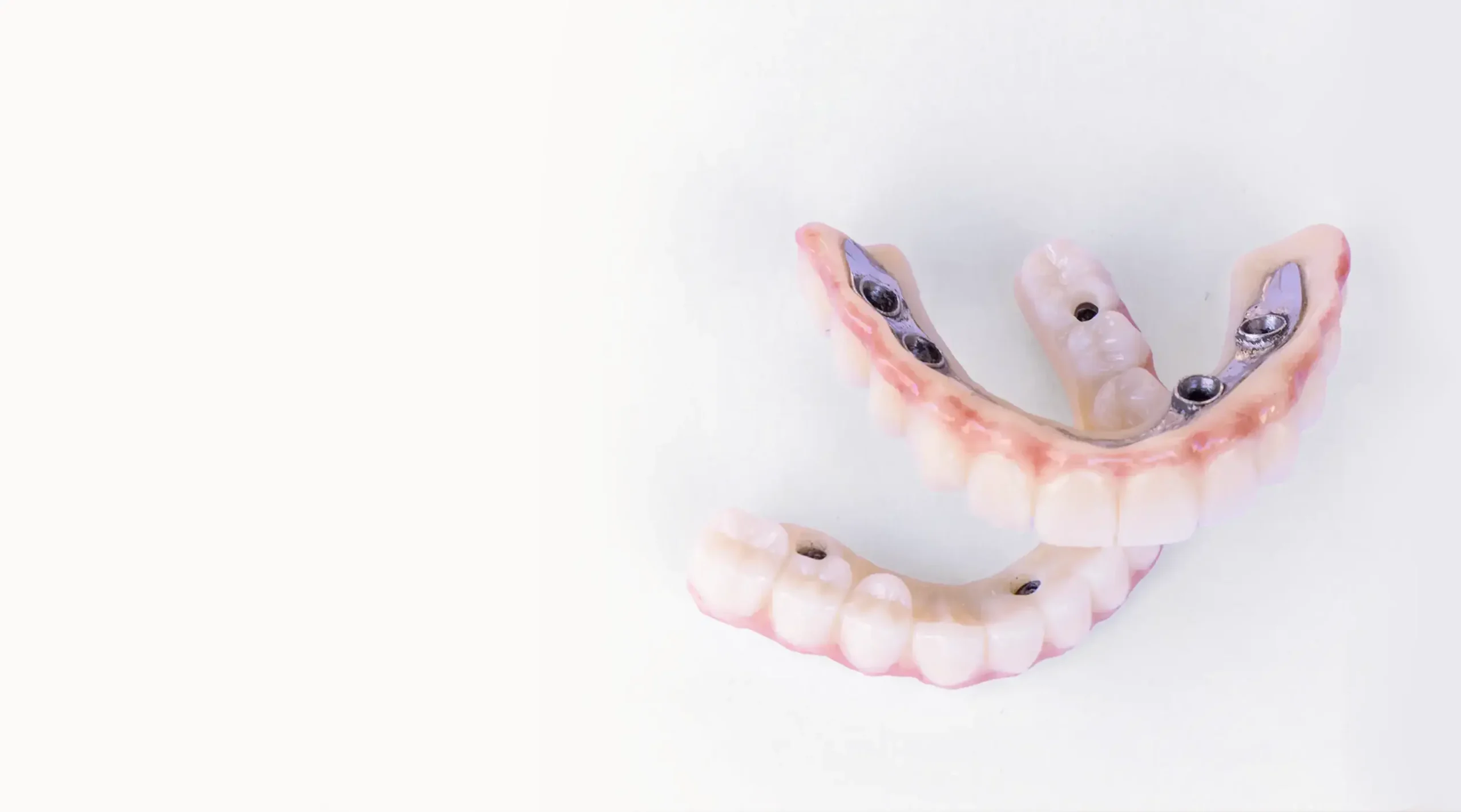
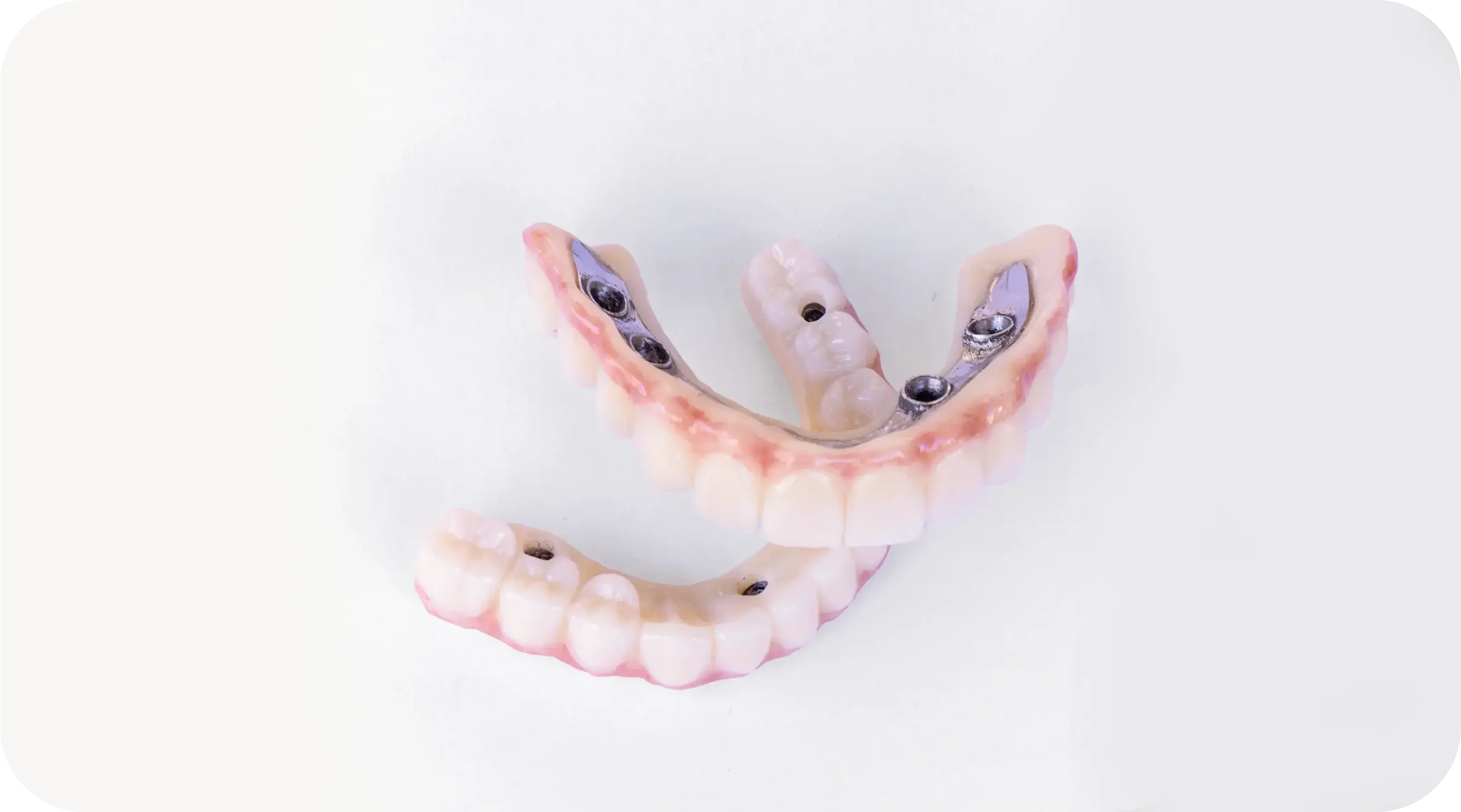
For anyone dealing with widespread tooth loss, All-on-4 represents something close to a clean slate. Rather than replacing teeth one at a time, or accepting a removable plate as the only realistic option, the technique anchors an entire arch of fixed teeth onto four titanium implants placed into your own jawbone. One surgery, one arch, one fixed result — and in most cases without the bone grafting that conventional implant placement would demand. For patients who have spent years managing a denture, or years avoiding the mirror, it is the treatment that changes the daily experience of having a mouth.
Albania has become a serious destination for this work, and Tirana in particular. The clinical standards are European, the materials come from the same manufacturers used in Milan or Munich, and the cost of running a clinic here is a fraction of what it is in Western Europe — which is why treatment that would be financially out of reach at home becomes achievable. The flights are short and direct from most of Europe, no visa is required for EU, UK or US citizens, and the country is small enough that the coast is a couple of hours from the clinic door.
That matters more than it sounds. All-on-4 is not a single appointment — it is a course of treatment with a healing period in the middle, and you will make the journey twice. Somewhere close, somewhere easy to reach, somewhere you do not mind spending a week is worth more here than in almost any other treatment.
Missing teeth change far more than a smile, and the changes compound.
Chewing turns into work. The list of foods you quietly avoid gets longer every year — steak, apples, crusty bread, anything that needs a proper bite — and with it goes a slice of your diet and a slice of your social life. Eating in company stops being relaxing.
Speech shifts too, usually in ways other people register before you do. Certain sounds soften. You start choosing words around the problem without noticing you are doing it.
And underneath all of it, the jawbone is disappearing. Bone is maintained by load: tooth roots transmit the force of every bite into the jaw, and the jaw responds by keeping itself dense. Remove the roots and that signal stops. The bone begins to resorb — slowly at first, then faster.
This is the mechanism behind the collapsed, foreshortened look that long-term denture wearers develop around the mouth. It is also why a denture that fitted well five years ago now rocks, rubs and needs steadily more adhesive. The plate has not changed shape. The jaw underneath it has.
All-on-4 addresses the cause rather than the appearance. Because the implants fuse directly into the bone and load it the way natural roots do, they restore the signal that keeps bone alive. They cannot rebuild what has already gone, but they substantially slow what would otherwise continue — something no denture, however well made, can do.
At Health Medical Center on Rruga e Kavajës in Tirana, the entire rebuild happens under one roof. The 3D scan, the surgical planning, the extractions, the implant placement, the temporary bridge, the final bridge — one building, one team, one set of people who know your case from the first photograph you send us to the day you fly home with the finished result.
That continuity is not a comfort feature. Full-arch work is a sequence in which every stage depends on decisions made in the one before it, and the most common way these cases go wrong is information getting lost between people. When the surgeon who placed your implants is the person assessing how they have healed, nothing has to be reconstructed from notes.
You arrive with a problem you have lived around for years. You leave your first visit with a fixed set of teeth already in place — not a plate, not a gap, not a promise. The definitive bridge comes on your second visit, once your jaw has healed properly around the implants.
You never spend a single day without teeth.
There is a real cost to postponing this, and it is not only emotional.
Every year spent with missing teeth is another year of bone loss, and bone is the one resource implant treatment cannot do without. The angled placement that makes All-on-4 possible works because there is dense bone available at the front of the jaw. That bone is finite, and it is being spent.
Wait long enough and the options narrow. What could have been four implants and a single straightforward surgery becomes four implants plus grafting, plus possibly a sinus lift, plus additional months of healing and additional cost. The same result, reached the long way round.
The teeth still in your mouth are also under pressure. They drift, they tilt into the gaps beside them, and they absorb bite forces they were never built to carry alone. Teeth that could have been saved at one point often cannot be a few years later.
None of this is an argument for rushing. It is an argument for finding out where you actually stand, which costs nothing — send us photographs and any recent scan and our clinical team will tell you honestly what your bone will support.
All-on-4 is a full-arch rehabilitation technique. Instead of giving every missing tooth its own implant, or placing six, eight or ten posts to carry a bridge, it uses four implants per jaw to support one complete fixed arch of teeth.
The defining feature is the angle. The two implants at the front of the jaw are placed vertically, in the conventional way. The two at the back are deliberately tilted, typically between 30 and 45 degrees.
That tilt is doing real structural work, and it is the reason the technique exists.
A tilted implant travels through a longer span of bone than a vertical one of the same length. Angling the rear implants forward lets them engage the dense bone at the front of the jaw — the part that survives tooth loss best — while spreading the support far enough back to carry a full arch without collapsing the whole load onto the front.
It also lets the implants avoid the two places surgeons most want to avoid. In the upper jaw, the maxillary sinus sits directly above the back teeth, and bone height there is often minimal after years of tooth loss. In the lower jaw, the inferior alveolar nerve runs through the posterior region. Tilting sidesteps both.
The practical consequence for patients is significant. Many people who have been told at home that they need bone grafting, or a sinus lift, or both, can be treated with neither. That removes an entire additional surgery, several months of healing, and a substantial part of the total cost.
It is not universal — some jaws genuinely need grafting, and we will tell you if yours is one of them. But it is common enough that a previous “you don’t have enough bone” is worth re-examining with a proper 3D scan before you accept it as final.
The bridge is fixed. It is screwed onto the implants, fitted by your dentist and removed only by your dentist — for maintenance, years apart, if at all.
This is the fundamental difference from a denture, and it changes almost everything about daily life. Nothing to take out at night. No adhesive. No palate coverage on the upper jaw, which means your sense of taste and temperature comes back — something upper denture wearers often say they had stopped expecting.
Bite force is the other difference. A conventional full denture returns a fraction of natural chewing power because it rests on gum tissue that was never designed to bear load. An implant-anchored arch transmits force into bone, the way teeth do. Most patients get most of their bite back.
Both restore a full fixed arch. The difference is how many implants carry the load, and the right answer comes from your bone rather than your preference or your budget.
All-on-4 is the more conservative surgery. Fewer implants, less bone required, a shorter procedure, a lower cost, and one of the best-documented treatment protocols in modern implant dentistry. Where bone volume is adequate, it is highly predictable.
All-on-6 distributes the load across six points instead of four. It tends to suit patients with good bone volume, heavier bite forces, a history of grinding, or an upper jaw — where bone is naturally softer and less dense than the lower, and where the extra support earns its place.
We decide from your 3D scan: bone volume, bone density, and where the force will fall when you bite.
If your scan supports four, six adds cost without adding benefit, and we will say so. If it supports six, we will say that too, rather than quietly fitting the plan to the more attractive number. This is one of the few decisions in dentistry where the cheaper option is frequently the correct one, and we would rather have that conversation before you book a flight than after.
It is not a same-day permanent result, and any clinic implying otherwise is describing something else.
What you receive on your first visit is a fixed provisional bridge — a genuine set of fixed teeth, screwed to the implants, that you eat and speak with. What it is not is the finished restoration. Implants need three to six months to fuse with bone before a definitive bridge can be loaded onto them, and no technique, technology or clinic compresses that timeline. Bone heals at the speed bone heals.
A clinic promising a permanent full arch in one week is either fitting a temporary and calling it permanent, or loading a final bridge onto implants that have not integrated. The first is a marketing decision. The second is a clinical risk you would be carrying home with you.
Your general health matters as much as your jaw does. Uncontrolled diabetes, active gum infection, heavy smoking and certain bone medications all affect how well implants integrate, so we review your medical history before planning. Most are managed rather than disqualifying — but they need to be known in advance, not discovered halfway through.
The final bridge is available in two materials, each with a different balance of cost, durability, and appearance:
A titanium framework faced with acrylic teeth and gum. Lower cost and lighter, though the acrylic surface wears faster and typically needs relining or replacement every 5 to 7 years.
A monolithic zirconia bridge milled from a single block. Highly resistant to wear, staining, and chipping, with a more natural, tooth-like translucency. Typically lasts 10 to 15 years or more before refurbishment.
All-on-4 is built for people who have lost most or all of the teeth in a jaw, or whose remaining teeth can no longer be saved:
All-on-4 isn't usually recommended for patients with uncontrolled diabetes, active gum infection, or heavy smoking, since these significantly affect implant integration. In these cases we typically recommend addressing the underlying issue first.
All-on-4 takes two visits to Tirana, with a healing period at home in between. That is not a scheduling inconvenience — it is biology. Implants need time to fuse with bone, and no clinic anywhere can compress that.
Send us photographs and any recent X-ray or CT scan. Our clinical team reviews your case and comes back with a preliminary plan — four implants or six, whether extractions are needed, and a written quotation. Free, no ob
On arrival you have a full clinical examination and a 3D scan. Implant positions, angles and lengths are planned against your real bone volume and density, with sinus position and nerve pathways mapped before anything be
Teeth that cannot be saved are removed, and four implants are placed under local anaesthetic — two vertical at the front, two angled at the back. Surgery usually takes around two hours per arch.
A fixed provisional bridge goes on before you fly home, so you leave with a complete set of teeth rather than a gap or a plate. You will be on a soft diet for a while as everything settles.
Over the next three to six months the implants fuse with your jawbone. You carry on with normal life with your temporary bridge in place, and we stay reachable by phone and email the whole way through.
On your second visit we take measurements, send them to the lab, and fit your definitive bridge — bite adjusted, every surface finished. This visit is considerably shorter than the first.
All-on-4 is unforgiving of guesswork - implant position, angle, and length all have to be right the first time. Every case at HMC is planned from a 3D CT scan against your own bone anatomy, not estimated from a panoramic X-ray, and you leave your first visit with a complete, fixed set of teeth rather than a gap or a removable plate.
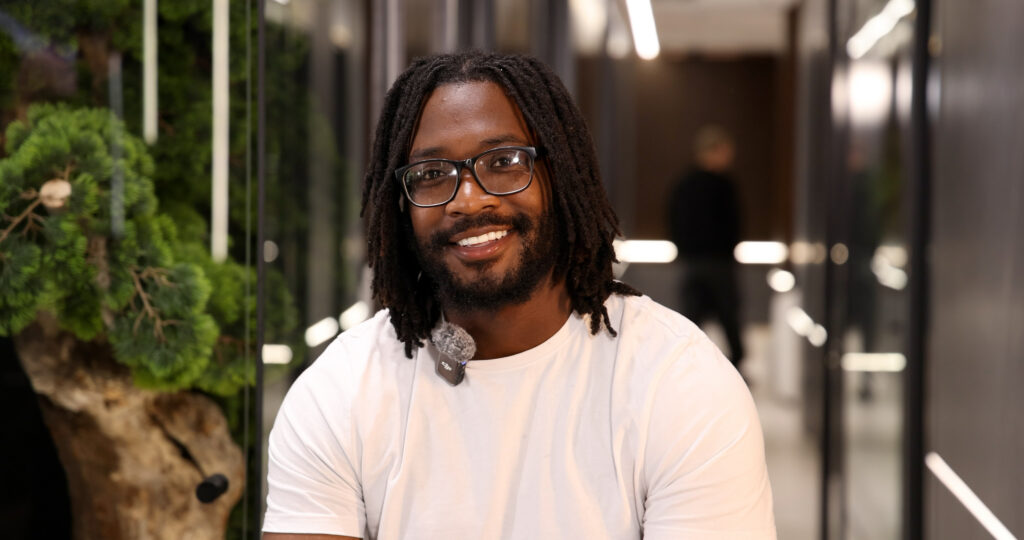
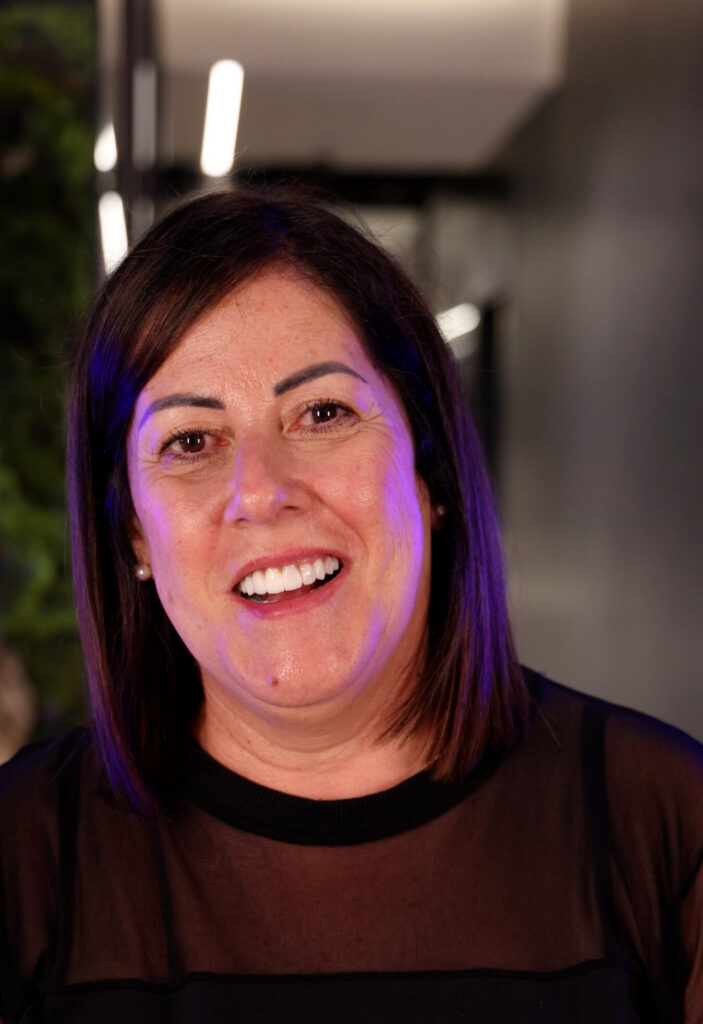
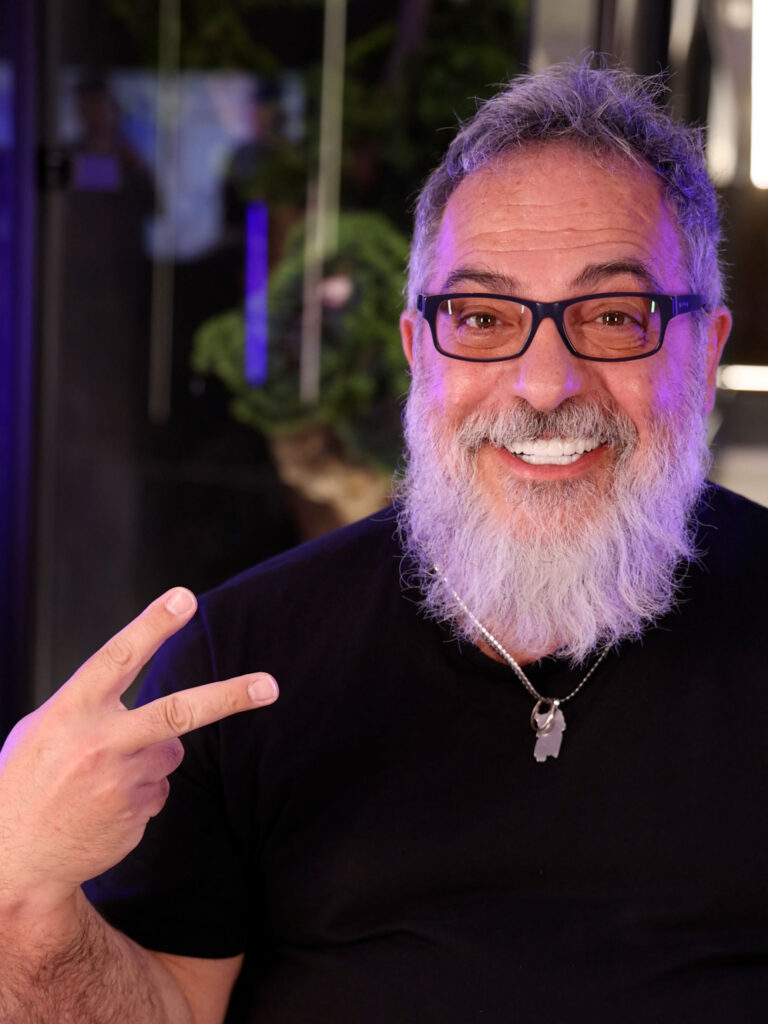
Hover over the image to reveal the result. Use the arrows or dots to browse cases.
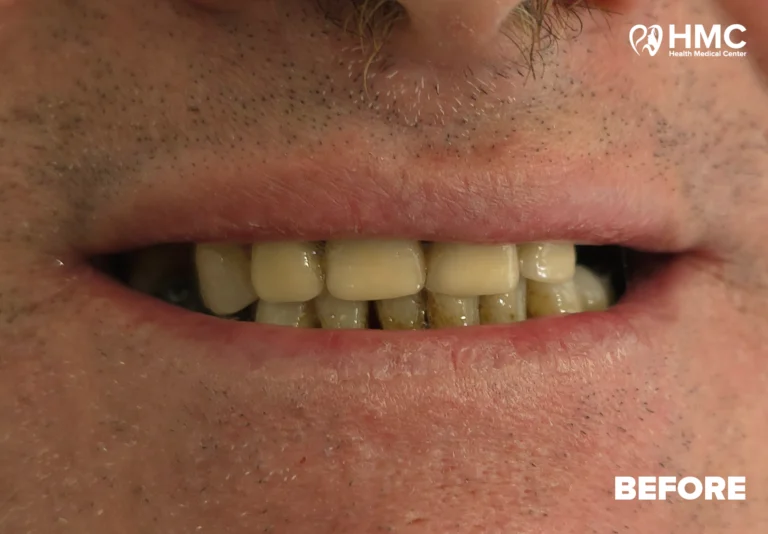
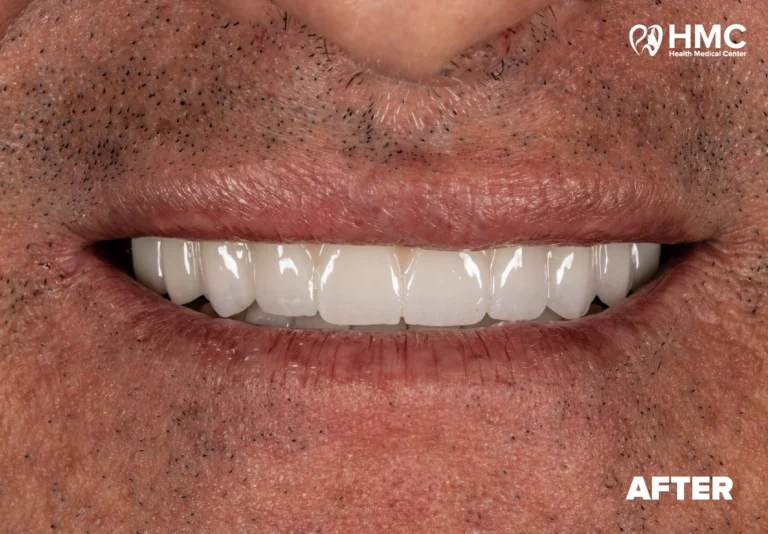
All-on-4 - Dental Smile Transformation
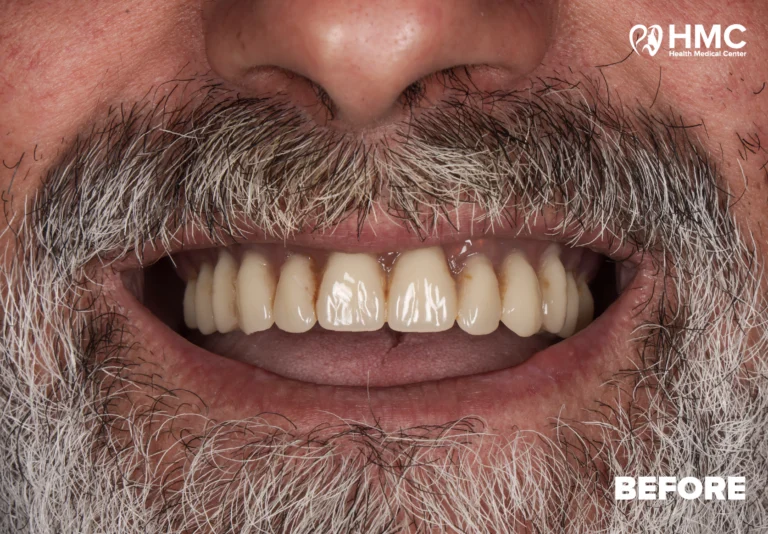
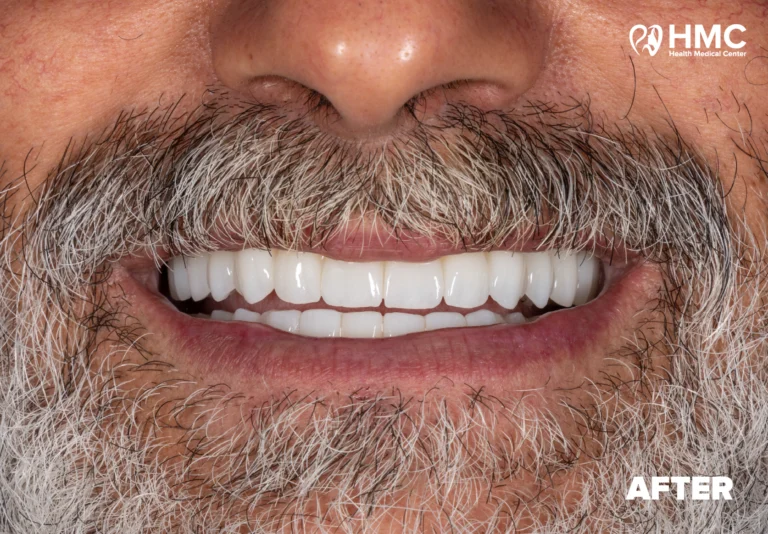
Enhanced Smile
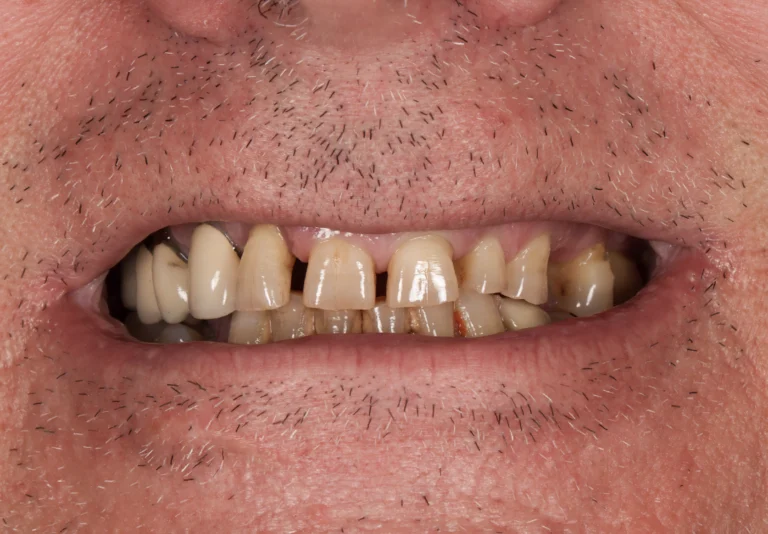
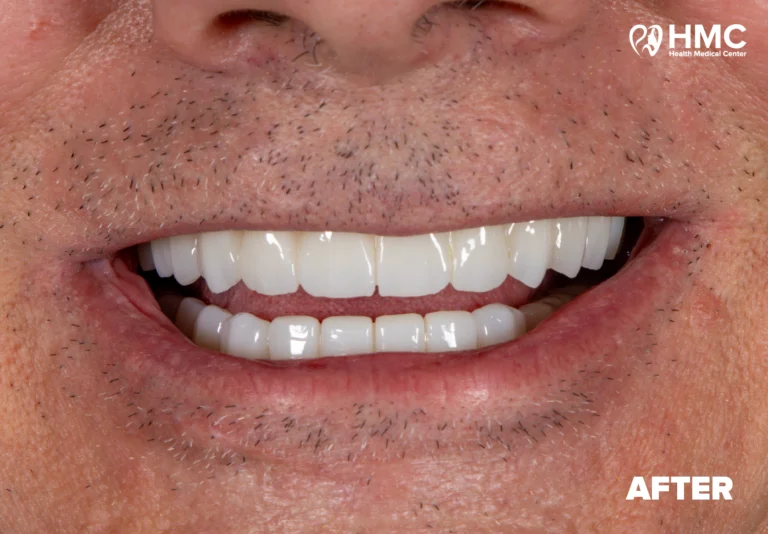
Full Smile Restoration with All-on-4 Dental Implants
Explore our full range of treatments
Yes. A fixed temporary bridge is attached at the end of your first visit, so you fly home with a complete set of teeth rather than a gap or a removable plate. This is one of the defining advantages of All-on-4 over conventional implant treatment, where patients often spend months in a removable denture while the implants heal underneath. The provisional bridge is screwed onto the implants, not resting on your gums. You eat with it, speak with it and sleep with it in. It is slightly lighter and less refined than the final bridge, and you will follow a soft diet for the first weeks to protect the healing implants, but functionally and visually it is a set of teeth. The definitive bridge is fitted on your second visit, once your jaw has healed around the implants and we can load them permanently. At no point between the two visits are you without teeth.
The procedure is done under local anaesthetic and is not painful. You will feel pressure and movement, and you will hear the instruments, but the area itself is fully numb. Most patients are surprised by how ordinary the experience is compared with what they had imagined. Afterwards, expect swelling and soreness for a few days. This peaks around day two or three and settles from there. It is manageable with standard prescription medication, and we send you home with clear instructions on what to take and when. Bruising around the jaw or cheek is normal and fades within a week or two. Most patients are back to light activity within a few days and describe the recovery as closer to a heavy dental appointment than to major surgery. If you are anxious about the procedure itself, tell us in advance — it is a common and entirely reasonable concern, and it is easier to address before the day than during it.
Yes, and any clinic telling you otherwise is worth questioning. Implants need three to six months to fuse with bone — a biological process called osseointegration — before a permanent bridge can be loaded onto them. That timeline is set by how bone heals, and it cannot be accelerated by technique, technology or expenditure. What happens in one visit is the surgical part: extractions if needed, implant placement, and the fixed temporary bridge. What happens on the second visit is the definitive restoration, measured and fitted once the foundation is solid. A clinic promising a permanent full arch in a single week is doing one of two things. Either they are fitting a temporary bridge and describing it as final, which is a wording choice. Or they are loading a permanent bridge onto implants that have not integrated, which is a clinical risk you carry home with you and only discover months later. We would rather be straightforward about the timeline than compete on a promise we do not think is safe to make.
That advice is usually correct about conventional implant placement and not necessarily correct about All-on-4. Standard implants are placed vertically, and in the back of the jaw — where bone resorbs fastest after tooth loss, and where the sinus sits in the upper jaw — there is often not enough vertical height to hold them. Hence the recommendation for grafting or a sinus lift. All-on-4 works differently. The two rear implants are angled forward, typically between 30 and 45 degrees, so they engage the denser bone at the front of the jaw while still spreading support far enough back to carry a full arch. This uses the bone you have rather than requiring bone you do not. In practice, a significant number of patients told elsewhere that they needed grafting can be treated without it. Not all — some jaws genuinely do need it, and we will say so plainly if yours is one. But a previous no is worth re-examining with a proper 3D scan before you accept it as final, because the scan gives a definite answer where an opinion does not.
Once healed, yes. A fixed arch restores most of your natural bite force because the load transmits into bone rather than pressing onto gum tissue. Patients routinely go back to foods they had written off years earlier — steak, apples, crusty bread, nuts. The temporary phase is different and it matters. For the first weeks after surgery you will follow a soft diet while the implants integrate, and this is the single instruction patients are most tempted to bend. The implants are stable at this stage but not yet fused, and excessive force during healing is one of the few genuine causes of early failure. We will give you specific written guidance on what to eat and when to progress. After the final bridge is fitted, most people stop thinking about their teeth altogether, which is rather the point. A few habits are worth keeping permanently: avoid using your teeth as tools, and be careful with very hard items like ice or bones, which can chip any restoration just as they chip natural teeth.
Yes, and often more natural than patients expect. The bridge is built to your facial proportions, lip line and tooth shade rather than to a standard template, and shade and shape are discussed and agreed with you before the final bridge is made. There is a second effect people rarely anticipate. When teeth are lost the bone recedes, and the lips and cheeks lose the structure that was supporting them from underneath — which is what produces the sunken, foreshortened look around the mouth. A full fixed arch restores that support. The soft tissue lifts back to roughly where it used to sit, which is why patients frequently look younger afterwards rather than simply better-toothed. Photographs before and after full-arch treatment often read as a change in the whole face, not just the smile. If you have particular preferences — a slightly brighter shade, a shape closer to how your own teeth looked — bring photographs of yourself from before the tooth loss. They are genuinely useful reference for the lab.
Mainly MegaGen, the South Korean manufacturer whose implants are used widely across Europe and are well documented for performance in softer or reduced bone — the exact conditions full-arch treatment tends to involve. We also place Straumann, the Swiss system with one of the longest clinical research records in implantology. Which system suits your case is part of the planning conversation rather than a decision made quietly on your behalf. Bone density, the angle required and the loading plan all feed into it, and we will explain the reasoning rather than simply announcing a brand. We think naming the manufacturer matters. A great deal of implant marketing refers to premium or high-quality implants without ever specifying which, and no patient can tell the difference by looking at their own mouth. The system going into your jaw is written on your quotation before you travel, so you can research it yourself and hold us to it. If you have had implants before and know which system was used, tell us — matching it can occasionally simplify future work.
There is more than one option, and it is decided as part of your treatment plan rather than assumed. Zirconia is the usual choice. Ours comes from Zirkonzahn, the manufacturer based in South Tyrol in northern Italy, whose systems are among the most respected in the industry. Zirconia is exceptionally strong, dimensionally stable and highly resistant to staining, which matters over a service life measured in years rather than months. It is the material most patients end up with. Metal-ceramic — porcelain layered over a metal framework — is the other established option and remains a thoroughly sound choice in plenty of cases. It has a long clinical track record, handles heavy bite forces well, and typically costs less than zirconia. The trade-off is in appearance: the metal substructure means it does not transmit light quite the way zirconia does. We go through the differences in strength, appearance and cost with you before anything is made, and whichever you choose is written on your quotation.
It raises the risk of implant failure, and it is worth being straightforward about why. Smoking restricts blood supply to the gums, which slows healing during the critical integration period, and it increases the long-term risk of peri-implantitis — the inflammatory condition around implants that is the most common cause of late failure. It is not an automatic disqualification and we will not refuse to treat you over it. Plenty of smokers have successful implant treatment. But the risk is real and measurable rather than a lecture, and you deserve to know it before you spend the money rather than afterwards. Cutting down in the weeks around surgery makes a genuine difference to how well the implants integrate — this is the period where blood supply matters most. If you can stop entirely for the healing phase, better again. And whether or not you change anything, being a smoker makes the ongoing cleaning routine and regular check-ups more important, not less. Tell us honestly at the assessment stage so we can plan realistically.
It is uncommon, but it does happen, and it is better to know that in advance than to discover it. Most failures occur early, in the first months, when an implant does not integrate with the bone as expected. You would usually notice discomfort or looseness. Contact us if anything feels wrong — the implant can generally be removed, the site allowed to heal, and a replacement placed afterwards. The design of a full arch works in your favour here. The bridge is carried on four implants, so one failing does not mean starting over from nothing. Late failures, years afterwards, are almost always peri-implantitis driven by plaque, which is why the cleaning routine and annual check-ups matter as much as they do. It is worth asking any clinic what happens if something goes wrong before you book, rather than assuming. We will tell you plainly, and we stay reachable throughout the healing period.
Plan on five to seven days for the first visit. The appointments are deliberately spread across it rather than stacked back to back: examination and 3D scan, then surgery, then fitting the fixed temporary bridge, with recovery days in between so nothing is rushed and we can check how you are healing before the next stage. The second visit is considerably shorter. It covers taking measurements, sending them to the lab, and fitting and adjusting your definitive bridge, and most patients plan on a few days. Exact scheduling is confirmed once your treatment plan is finalised, and we will give you the dates before you book flights rather than after. Most patients find the first visit works best as a proper week rather than a tight trip — the recovery days are quiet, and Tirana is an easy and inexpensive city to spend them in. If you are travelling with someone, that tends to make the surgery days considerably easier.
A direct contact number stays open to you, and our team works in English, Italian, Spanish, French and Greek — so you can describe what is happening in your own language rather than translating a medical concern into a second one. This matters most in the months between visits, which is exactly when questions surface. Something feels different. You are unsure whether a degree of swelling is normal or not. You want to check whether you can move on from soft foods yet, or what to do about a small chip in the temporary bridge. These are ordinary questions, and the answer is usually reassuring, but not being able to ask anyone is what turns them into worry. You also leave with written aftercare instructions rather than relying on what you remember from the appointment, covering cleaning, diet and what warrants getting in touch. If something needs looking at in person, we will help you arrange the trip around it.
4.9
/ 1006 reviews
“I travelled from the UK for 3 dental implants and was so nervous, but the team made me feel comfortable and reassured every step of the way. Dr Idris and his team were professional and genuinely caring.”
“My whole experience with HMC has been incredible. I was a bit scared about travelling from the UK to get an implant done, but there was nothing to be scared of. The procedure was quick and painless and they supported me 24/7 once I got back home.”
“I had a great experience with my dental implant. The doctor was very professional, patient, and made me feel comfortable throughout the whole process. The entire staff made the experience easy and stress-free. Would definitely recommend!”
Send us a few details and our patient coordinators will come back within 24 hours with a treatment plan, timeline, and price. No obligation.