Rebuilding bone height in the upper jaw so implants can be placed
Extra bone height added above the upper back teeth, opening the door to implants where there wasn't room before.

 1000+ Google reviews

 Excellent on Trustpilot
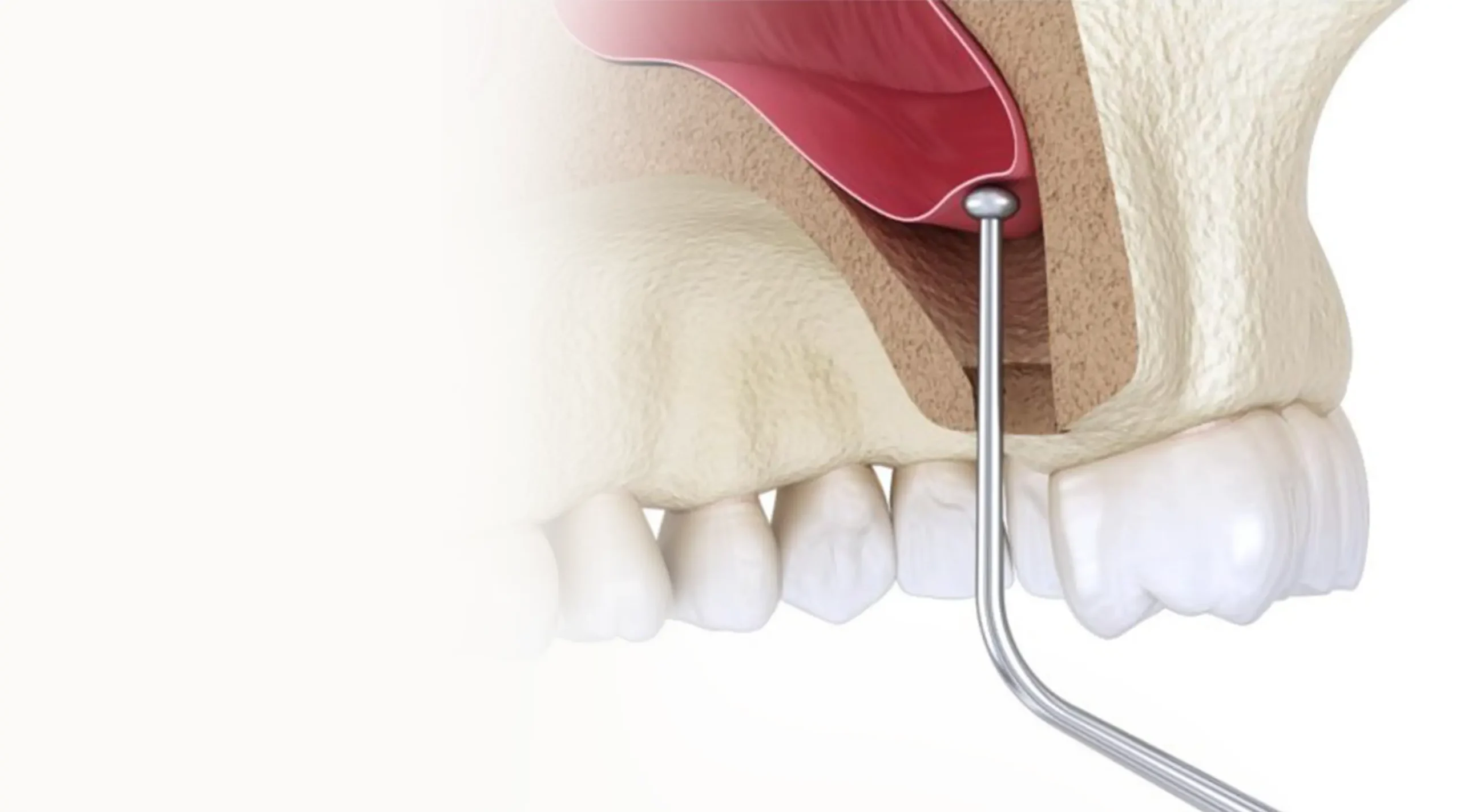
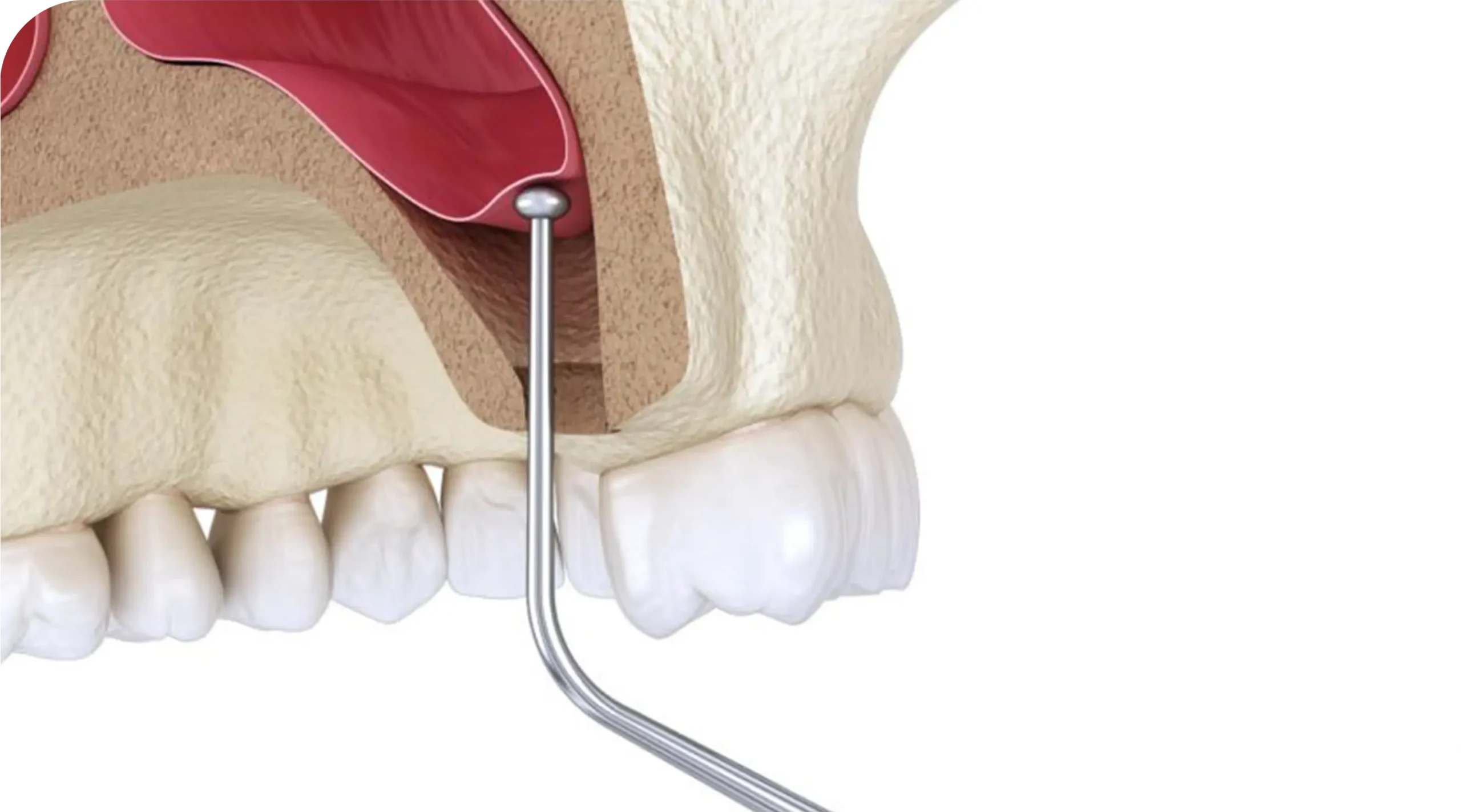
A sinus lift rebuilds bone height in the upper back jaw so that implants have something solid to anchor into.
It is preparation, not treatment. Nobody wants a sinus lift; they want the implants it makes possible. Which is why the most useful thing we can tell you about it is that you may not need one.
Two things happen at once, and they work in the same direction.
When an upper molar is lost, the bone that held it stops being loaded and begins to resorb from below — the ridge gets shorter.
Meanwhile the maxillary sinus, the air-filled cavity sitting directly above those teeth, tends to expand downward into the space left behind. The floor of the sinus drops as the ridge rises to meet it.
The result is a thin band of bone between the two, sometimes only two or three millimetres, where an implant needs considerably more. This is why upper back teeth are the hardest place in the mouth to place implants, and why people are so often told it cannot be done.
The sinus is lined with a thin membrane. A sinus lift does not open the sinus — it separates that membrane from the bone beneath and raises it slightly, then fills the space created underneath with graft material.
Over the following months your own bone grows through that material and replaces it. The sinus ends up sitting a few millimetres higher, with solid bone beneath it where there was almost none.
The implant then anchors into your own regenerated bone, not into the graft.
A great many patients arrive having been told they need bilateral sinus lifts, and leave having had neither.
Angled implant placement — the principle behind All-on-4 — tilts implants forward to engage the denser bone at the front of the jaw, bypassing the sinus completely. Shorter implants can work where height is limited but width is good.
Neither is a trick. They are established techniques that use the bone you have rather than building bone you do not.
Sometimes the answer really is that you need a lift, and we will say so plainly. But it costs money, adds months and adds a procedure, so it is worth being certain first. A 3D scan settles it.
There are two approaches. Which one your case needs is decided by how many millimetres have to be gained, and the scan answers that before anything is planned.
Where only a few millimetres are needed, the sinus floor can be raised through the same channel that is being prepared for the implant itself.
No separate opening is made. The bone at the top of the channel is gently tapped upward, lifting the membrane with it, and graft material is introduced through the same access. Because the implant site and the lift are one and the same, the implant frequently goes in at the same appointment.
Less invasive, faster healing, and where it is possible it is clearly the better option.
Where more height is required, access is made through a small window in the side of the jaw, above the gumline.
This gives direct visibility of the membrane, which is what makes larger lifts predictable. The membrane is separated and raised carefully, graft material is packed into the space beneath it, and the window is closed.
It is the more involved procedure and it needs a longer consolidation period before implants can be loaded. But for significant height gains it is the reliable choice, and attempting to force a crestal lift beyond its range is how membranes tear.
This is the question that most affects your cost and your calendar.
If enough bone already exists to hold an implant steady while the graft matures around it — broadly four to five millimetres or more — the lift and the implant can be done together. One procedure, one healing period, one trip.
Below that threshold the implant has nothing to grip, so the lift is done alone and left to consolidate for several months before implants are placed. Two stages, two trips.
We will tell you which applies from the scan, before you book flights, because the difference is substantial.
More than for any other implant procedure, a sinus lift depends on knowing the anatomy in advance.
A panoramic X-ray flattens a three-dimensional cavity into two dimensions. It cannot show you the true shape of the sinus floor, or the bony septa that divide some sinuses into compartments and change entirely how the membrane must be lifted.
Finding a septum during surgery rather than before it is the difference between a planned procedure and an improvised one.
Not everyone who is told they need one actually does. Angled implant placement and shorter implants can often reach usable bone without lifting the sinus at all — which is why a previous "you need a sinus lift" is worth re-examining with a 3D scan before you accept it. We will tell you honestly which applies to you, including when the answer is that you do need one.
Two approaches, chosen by how much height has to be gained. The scan decides which, not preference:
Where only a few millimetres are needed. The sinus floor is raised through the same channel prepared for the implant, so there is no separate opening. Less invasive, faster healing, and often done at the same appointment
Where more height is required. A small access window is made in the side of the jaw, the sinus membrane lifted and graft material placed beneath it. More predictable for larger gains, with a longer healing period before
A sinus lift may be needed if you:
A sinus lift is never the goal. It is what makes implants possible where bone height has run out, and if your case can reach the same result without one, we will tell you.
A sinus lift is a single appointment under local anaesthetic. The healing that follows is what takes time:
The scan measures existing bone height beneath the sinus and shows the shape of the sinus floor. This decides the approach, the amount of graft needed, and whether implants can go in at the same time.
The area is numbed thoroughly. A sinus lift sounds more alarming than it feels — the sinus membrane itself has no sensation, and patients consistently report less discomfort than they expected.
The sinus membrane is separated from the bone and raised gently. This is the delicate part of the procedure and the reason it is done slowly rather than quickly.
Graft material is placed into the space created beneath the lifted membrane. Over the following months your own bone grows through and replaces it, forming the height the implant will anchor into.
Four to nine months for the graft to consolidate, depending on how much was placed. Where the lift was small, implants may already be in; where it was larger, they follow afterwards.
We will tell you if you do not need one. A sinus lift adds cost, adds months and adds a surgical procedure, and there are cases where angled placement reaches the same result without it. That assessment comes from your 3D scan, and it is made before you book flights rather than discovered in the chair.
Explore our full range of treatments
Possibly not, and this is worth checking properly before you accept it. A sinus lift is recommended when there is not enough bone height between the ridge and the sinus floor to hold an implant securely. That measurement is real, but the conclusion drawn from it depends on the technique being planned. Conventional implants are placed vertically, straight up into that limited height. Angled placement — the principle behind All-on-4 — tilts the implant to engage denser bone further forward, avoiding the sinus entirely. Shorter implants can also work where height is modest but width is good. So a patient told at home that they need bilateral sinus lifts may turn out to need one, or none. A 3D scan gives the definite answer. We would rather tell you that you do not need a procedure than sell you one you do not.
Less than almost anyone expects, and this surprises patients more than any other treatment we do. The area is numbed with local anaesthetic. Crucially, the sinus membrane itself has no pain sensation — what you feel is pressure and vibration in the cheek, not pain. Most patients describe the experience as odd rather than unpleasant. Afterwards, expect swelling and some bruising over the cheek for several days, and a feeling of fullness on that side. It is manageable with ordinary prescribed medication. Most people are back to light activity within two or three days. If the idea of surgery near the sinus makes you anxious, say so when you book. It is a common and entirely reasonable worry, and easier to plan around than to manage on the day.
Four to nine months, depending on how much height was gained. A small crestal lift consolidates faster and often allows implants at the same appointment. A larger lateral window lift, where several millimetres of graft were placed, needs longer — typically six to nine months before the bone is solid enough to load an implant. The graft is not bone yet when it goes in. It is a scaffold that your own bone grows through and gradually replaces. Loading an implant into it too early is one of the few genuine ways to lose the whole result, which is why the timeline is not negotiable. We will give you the expected schedule before you travel, so you can plan the second trip around it rather than waiting to be told.
Sometimes, and it is the best outcome when it is possible. Simultaneous placement works when there is enough existing bone to hold the implant stable while the graft matures around it — usually four to five millimetres or more. In those cases the lift and the implant happen in one appointment, one healing period, and one trip. Where existing height is less than that, the implant would have nothing to grip. The lift is done first, left to consolidate, and implants placed afterwards. This is the staged approach and it is more predictable when height is genuinely short. The scan tells us which applies before you book. It makes a substantial difference to both cost and timeline, so it is worth knowing early.
Granular graft material that acts as a scaffold rather than as a permanent filler. The important thing to understand is what happens to it. The graft does not stay as graft. It holds the space beneath the lifted membrane while your own bone grows into and through it, and over the following months it is progressively replaced by your own living bone. What eventually anchors the implant is you, not the material. The specific material used is confirmed as part of your treatment plan and appears on your written quotation, as does the implant system going in afterwards. If you have preferences or concerns about graft origin, raise them at the assessment stage — it is a reasonable question and we would rather answer it in advance.
It is delicate work, but it is routine and very well documented. The sinus is an air-filled cavity lined with a thin membrane. A sinus lift does not enter the sinus — it lifts that membrane upward and places graft material beneath it, so the sinus remains sealed and simply sits slightly higher than before. The skill is in separating the membrane without tearing it, which is why the procedure is done slowly and why the 3D scan matters: it shows the shape of the sinus floor, any septa dividing it, and exactly where the membrane will need to lift. Complications are uncommon in planned cases. What raises risk is working blind from a two-dimensional X-ray, which is precisely what the scan removes.
Straightforward, with a few specific instructions that matter more than usual. Expect swelling and bruising over the cheek for several days, peaking around day two or three. A feeling of pressure or fullness on that side is normal. The instructions people must follow: do not blow your nose for the first two weeks, sneeze with your mouth open, and avoid flying immediately afterwards if you can — all of these change pressure in the sinus and can disturb the graft before it has stabilised. If you must fly, we will tell you what interval is sensible. No heavy lifting or strenuous exercise for a week. Otherwise most patients are back to normal activity within two or three days, and you leave with written instructions covering all of it.
No. A healed sinus lift does not affect breathing, sinus function or how you feel day to day. The sinus is not reduced in any way that matters — you are gaining a few millimetres at the floor of a cavity that remains fully functional. Patients do not report changes in airflow, drainage or sinus infections afterwards. In the first weeks there can be a sensation of fullness on that side while swelling settles. That resolves as healing progresses. If you already have a history of chronic sinusitis or nasal obstruction, tell us at the assessment. It does not necessarily prevent treatment, but it affects timing and sometimes means treating that first.
It is the most common complication, it is usually manageable, and it is better to know about it in advance. Small perforations of the membrane happen and are often repaired during the same procedure with a resorbable barrier, allowing the lift to continue as planned. Where a tear is large, the right decision is to stop, allow the membrane to heal — which it does reliably over a few months — and repeat the lift afterwards. That is frustrating but it is the correct call, and pushing on regardless is how cases fail. We will tell you if this happens and why, rather than discovering it later. A 3D scan reduces the likelihood considerably by showing the membrane's shape and any septa before we begin.
Yes. Once the graft has consolidated into your own bone, it behaves like the rest of your jaw. What keeps it there is the implant. Bone is maintained by load, so an implant placed into the grafted site keeps stimulating that bone in the same way a natural root would. That is why a sinus lift is done as preparation for implants rather than on its own. Where a graft is placed and then no implant follows, the new bone will gradually resorb, exactly as the original bone did after the teeth were lost. The graft is not the treatment; it is the foundation for one. With implants in place and healthy gums, the result is permanent.
Lower operating costs, not lower standards. A sinus lift in the UK, Ireland or Italy often costs more on its own than the implants it enables, which is why so many patients simply give up on upper implants and accept a denture instead. In Tirana the same procedure, the same graft material and the same 3D planning cost a fraction of that, because rent, salaries and the general cost of running a clinic here are lower. What does not change is the specification. The scan is the same scan. The implants afterwards are MegaGen or Straumann. It also means the calculation shifts. Treatments that were financially out of reach — a full upper arch with grafting — become realistic, which is the actual reason most patients come.
Send us a few details and our patient coordinators will come back within 24 hours with a treatment plan, timeline, and price. No obligation.