One missing tooth replaced with a titanium root and a custom crown
Missing a tooth? A single implant fills the gap with a titanium root and a lifelike crown, leaving the teeth around it untouched.

 1000+ Google reviews

 Excellent on Trustpilot
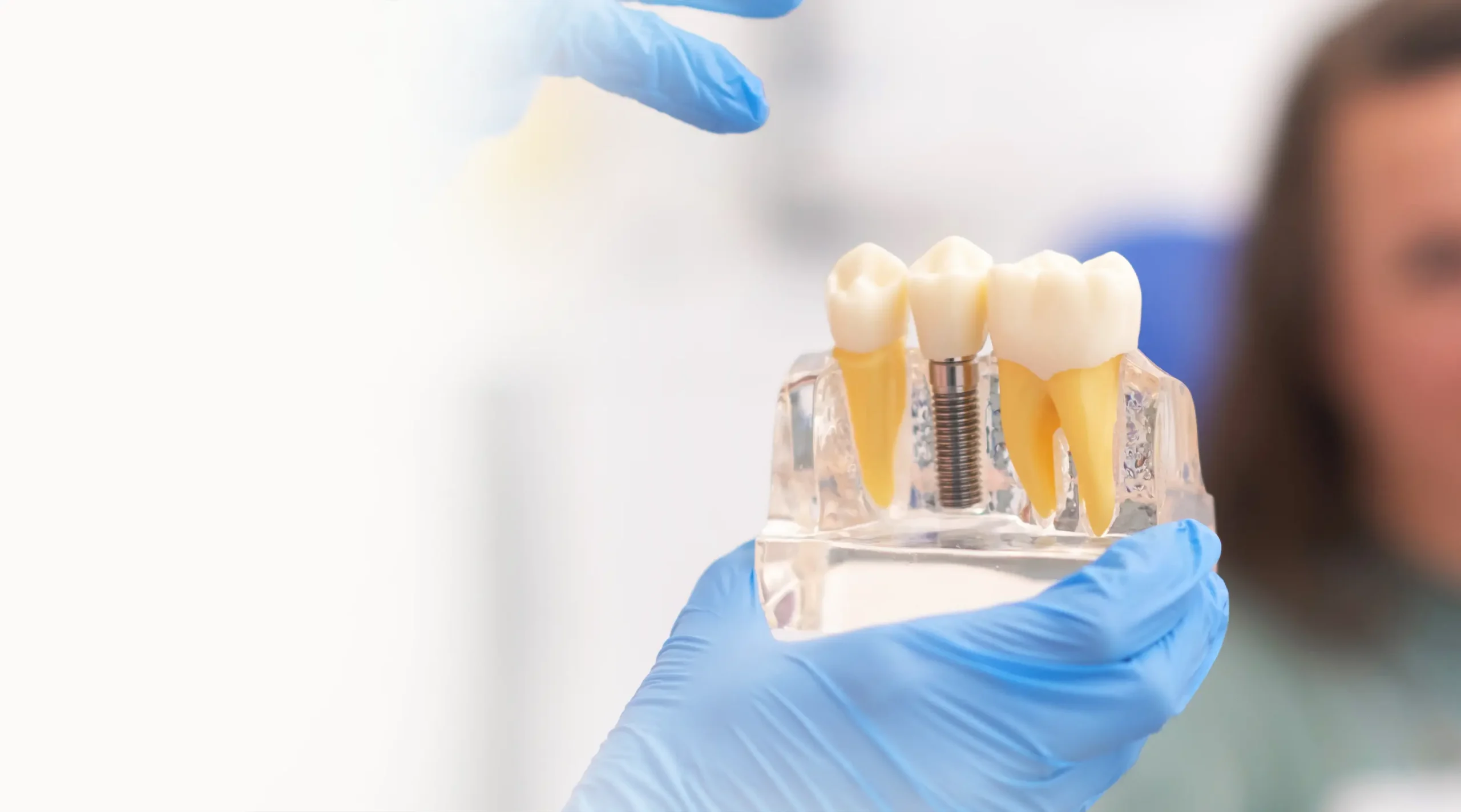
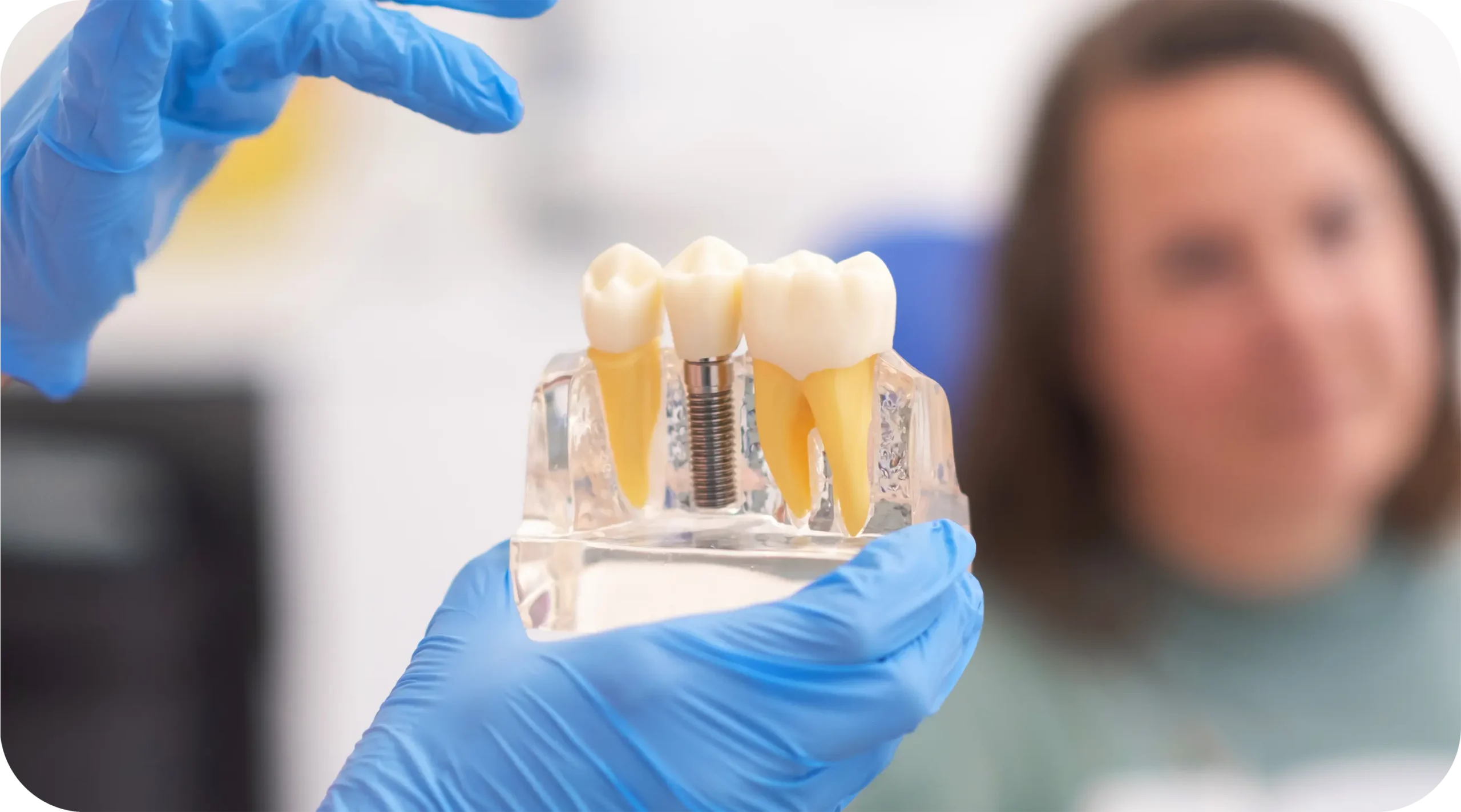
A single dental implant replaces one missing tooth: a titanium root in the jawbone, a custom crown on top, the neighbouring teeth untouched.
One missing tooth feels like a small problem. It is the gap people genuinely learn to live with — chewing on the other side, smiling slightly narrower, meaning to sort it out eventually.
But it is not a plate, and not a bridge suspended from the neighbours. It is a tooth anchored in bone, brushed like a tooth and bitten with like a tooth.
Teeth hold each other in position. Remove one and the arrangement starts to move.
The teeth either side tilt towards the space, slowly and without any sensation. The tooth above or below — with nothing to bite against — over-erupts, drifting into the gap from the opposite jaw. Contacts that were tight open up, and food starts packing into places it never used to.
Underneath, the bone that held the root is no longer being loaded. Bone maintains itself by being used, so it begins to resorb: fastest in the first year, then more slowly, indefinitely.
None of this is dramatic month to month. Over five years it turns one missing tooth into a bite problem involving three or four, and a site with less bone available than it had.
Most people weighing up one missing tooth are choosing between these two, and the difference is worth understanding before someone recommends one.
A bridge crowns the healthy teeth either side of the gap and suspends a false tooth between them. Faster, cheaper up front, no surgery. The price is that two intact teeth are filed down permanently to solve a third tooth's problem — and the bone under the gap keeps shrinking regardless.
A single dental implant replaces the root as well as the crown. The neighbours stay untouched. The bone stays loaded. It costs more at the start and takes months rather than weeks, and it generally lasts far longer.
There are cases where a bridge is genuinely the better answer, and we will say so when that is true. But if the teeth either side are healthy, grinding them down is a real cost, and one that rarely appears on a quotation.
A single dental implant is three separate components, and it helps to know which is which, because they behave very differently over time.
The implant is a titanium screw placed into the jawbone, taking the place of the root. Titanium is used because bone bonds directly to it — a process called osseointegration — rather than simply healing around it.
The abutment is the connector that sits on the implant and passes through the gum.
The crown is the visible tooth, made in the lab and shaded to your neighbouring teeth.
Only the crown is ever visible. Only the crown wears out. The implant, if the gum around it stays healthy, is a permanent fixture.
An implant has to go in a specific place, at a specific angle, at a specific depth, and there is very little margin.
In the upper jaw the maxillary sinus sits above the back teeth, and after years without a tooth the bone height beneath it can be minimal. In the lower jaw the inferior alveolar nerve runs through the posterior region and must be avoided with a clear margin. Between the neighbouring teeth there is a finite width, and the implant plus the bone around it has to fit inside it.
A panoramic X-ray flattens all of this into two dimensions. A 3D scan does not — it shows bone volume, bone density, and exactly where the anatomy you need to avoid actually is. That is why the scan happens before the plan, not as a formality afterwards.
If the tooth is still in place, or has come out recently, the sequence changes.
Sometimes a single dental implant can be placed into the socket at the same appointment as the extraction, which preserves bone and saves months. This depends on there being no active infection and enough intact bone around the socket.
More often the site is left to heal for a few months first, and the implant placed into healed bone. This is the more predictable route and the one we will recommend where there is any doubt.
If you still have the tooth and know it is failing, it is worth asking about this before it is extracted. The decision is easier to make with the tooth still in the mouth than after the socket has healed over.
A long-standing gap has usually lost width and height, and occasionally there is not enough left to hold an implant securely.
Grafting rebuilds the site. For a single tooth this is generally a small procedure rather than a major one, and it adds a healing stage before the implant goes in.
The scan tells us whether it is needed. We would rather say so before you book flights than discover it in the chair.
Health matters as much as the jaw does. Uncontrolled diabetes, active gum infection, heavy smoking and certain bone medications all affect how well an implant integrates, so we review your medical history before planning. Most are managed rather than disqualifying — but they need to be known in advance, not discovered halfway through.
Both are established systems with substantial clinical documentation. Which suits your case is decided from your scan, not from a price list:
The South Korean system we place most often, used widely across Europe and well documented for performance in softer or reduced bone — the conditions a healed extraction site frequently presents.
The Swiss system with one of the longest clinical research records in implantology. Chosen where the case calls for it, and priced separately where applicable.
The crown that sits on top is made from Zirkonzahn zirconia, shaped and shaded to your neighbouring teeth. Strong, stain-resistant, and the part of the implant anyone will ever see.
A single dental implant is usually the right answer if you:
One missing back tooth matters as much as a missing front one. The front tooth is the one you notice — the back one is the one doing the chewing, and losing it quietly shifts load onto teeth that were never meant to carry it.
A single dental implant takes two visits to Tirana, separated by a healing period at home. The surgery itself is short; the waiting is biology:
A full examination and a 3D scan of the site. Bone volume and density, the position of the sinus or nerve, and the space between the neighbouring teeth all determine implant size and angle.
The implant is placed under local anaesthetic, usually in under an hour for a single tooth. Most patients are surprised how much shorter it is than the extraction that created the gap.
Three to six months while the implant fuses with the bone. You go home and carry on normally, and we stay reachable by phone and email throughout.
On your second visit we take measurements and send them to the lab, where the crown is built to match the shade, shape and translucency of the teeth either side.
The crown is fitted onto the implant, the bite is checked and adjusted, and the contacts with the neighbouring teeth are finished so floss passes cleanly.
We tell you which implant is going into your jaw, by name, before you travel — and it is written on your quotation. A single dental implant is a small treatment with a long life ahead of it, and the thing that determines that life is what was put in and how precisely it was placed, neither of which you can inspect afterwards.
Explore our full range of treatments
This is the real decision, and it is worth understanding properly rather than taking a recommendation on trust. A bridge replaces the missing tooth by crowning the two healthy teeth either side and suspending a false tooth between them. It is faster, cheaper up front, and needs no surgery. The cost is that two healthy teeth are filed down to take crowns — permanently, and for the sake of a third tooth's problem. It also does nothing for the bone underneath the gap, which continues to shrink. A single dental implant replaces the root as well as the crown. The neighbouring teeth are not touched. The bone is loaded and therefore maintained. It takes longer and costs more at the outset, but it typically lasts far longer and leaves your other teeth intact. There are cases where a bridge is the better answer — insufficient bone with no appetite for grafting, or neighbouring teeth that already need crowns anyway. We will say so when that is true. But if the teeth either side are healthy, filing them down is a real price to pay.
Sometimes, but not usually, and we would rather explain why than promise it. Immediate loading — fitting a crown at the same appointment as the implant — is possible in specific circumstances: good bone density, excellent primary stability at placement, and a bite that does not load the tooth heavily. Those conditions are more common at the front than the back. What is fitted on the day, when it is fitted, is a temporary crown rather than the final one. The definitive crown still waits for integration. In most cases the honest sequence is implant first, healing, then crown. It is three to six months of biology that cannot be shortened by technique or by paying more. If the gap is visible when you smile, we will discuss a temporary option so you are not walking around with a space in the meantime.
The implant and the crown age differently. The implant is a titanium post integrated into living bone. With healthy gums and consistent hygiene it commonly lasts decades and frequently for life. What threatens it is not wear but peri-implantitis — inflammation around the implant driven by plaque, the same process as gum disease — which is largely preventable. The crown is a restoration and wears like one. Expect somewhere in the region of 10 to 15 years before it may need replacing, depending on bite force and grinding. Replacing a crown is straightforward because the implant underneath stays where it is. The expensive, surgical part is done once. That is the main reason an implant works out well over a long horizon even though it costs more than a bridge at the start.
Less than most people expect, and generally less than the extraction that created the gap. The site is numbed with local anaesthetic. You feel pressure and movement but not pain. For a single tooth the placement itself is often under an hour, and a good deal of that is preparation rather than surgery. Afterwards, expect some swelling and tenderness for a few days, manageable with ordinary painkillers. Most patients are back to normal activity the next day and describe it as a smaller event than they had braced for. If you are anxious about dental treatment, say so when you book rather than on the day. It is easier to plan around than to manage in the chair.
It matters, but it rarely rules anything out. Bone is maintained by load. Once a tooth is gone, the bone that held it stops being stimulated and begins to resorb — fastest in the first year, then more slowly. A gap that has been there for a decade will usually have less bone than one from last year. What that changes is planning, not possibility. The 3D scan shows exactly how much bone is there and in what shape. In many long-standing gaps there is still ample bone for a standard implant. In some, a graft is needed first, which adds a stage and some healing time. The teeth either side will also have drifted and tilted towards the space over the years, which can narrow the gap. Occasionally that needs addressing before an implant will fit properly. The scan tells us, and we tell you before you book anything.
That is the main technical challenge of a single front implant, and it is harder than matching a full set. When every tooth is being replaced, they only need to match each other. A single crown has to disappear between two natural teeth that have their own shade, translucency, surface texture and small imperfections. The shade is taken against your actual neighbouring teeth and sent to the lab with the measurements. Zirconia handles this well — it transmits light in a way that reads as tooth rather than as a flat block of colour. One honest note: if you are also planning whitening, do it before the crown is made. Crowns do not respond to whitening agents, so a crown matched to unwhitened teeth will be left behind if you brighten the rest afterwards.
Mainly MegaGen, the South Korean manufacturer used widely across Europe and well documented for performance in softer or reduced bone. We also place Straumann, the Swiss system with one of the longest clinical research records in implantology. Which one suits your case is decided from your scan and discussed with you, not chosen quietly on your behalf. The system going into your jaw is written on your quotation before you travel, so you can look it up and hold us to it. A great deal of implant marketing refers to premium implants without naming one. Nobody can tell the difference by looking in their own mouth, which is exactly why naming it matters.
For the standard protocol, yes. The implant needs three to six months to fuse with bone before a final crown can be loaded onto it, and that timeline is set by healing rather than by scheduling. The upside for a single tooth is that both visits are short. The placement is often one appointment; the crown visit is measurements, then fitting. Neither requires the kind of stay a full-arch case does. This is why most patients combine the first visit with something else — a cleaning, whitening, a crown on another tooth — rather than flying out for a single appointment. We will help sequence it so the trip is worth making.
Yes, and arguably more than for a front tooth. The front tooth is the one you notice. The back tooth is the one doing the work. Molars generate most of your chewing force, and when one goes the load redistributes onto teeth that were not designed to carry it — which over years contributes to cracks, wear and further failures. The tooth above or below the gap also has nothing to bite against and will gradually over-erupt, drifting down or up into the space. The teeth either side tilt towards it. What started as one missing tooth becomes a bite problem involving three or four. And the bone underneath keeps shrinking whether or not anyone can see the gap.
It raises the risk of failure, and it is worth being straightforward about why. Smoking restricts blood supply to the gums, which slows healing during the critical integration period, and raises the long-term risk of peri-implantitis. It is not an automatic disqualification and we will not refuse to treat you over it. Plenty of smokers have entirely successful implants. But the risk is real and measurable, and you deserve to know it before you spend the money. Cutting down in the weeks around the surgery makes a genuine difference to integration. Whether or not you change anything, being a smoker makes the cleaning routine and regular check-ups more important, not less.
It is uncommon for a single dental implant, but it happens, and it is better to know in advance. Most failures occur early, in the first months, when the implant does not integrate as expected. You would usually notice discomfort or looseness. Contact us — the implant can generally be removed, the site left to heal, and a replacement placed afterwards. Late failures, years later, are almost always peri-implantitis driven by plaque, which is why hygiene and annual check-ups carry the weight they do. We will tell you plainly what happens if something goes wrong, before you book rather than after. A direct contact number stays open to you throughout the healing period.
4.9
/ 1006 reviews
“I travelled from the UK for 3 dental implants and was so nervous, but the team made me feel comfortable and reassured every step of the way. Dr Idris and his team were professional and genuinely caring.”
“My whole experience with HMC has been incredible. I was a bit scared about travelling from the UK to get an implant done, but there was nothing to be scared of. The procedure was quick and painless and they supported me 24/7 once I got back home.”
“I had a great experience with my dental implant. The doctor was very professional, patient, and made me feel comfortable throughout the whole process. The entire staff made the experience easy and stress-free. Would definitely recommend!”
Send us a few details and our patient coordinators will come back within 24 hours with a treatment plan, timeline, and price. No obligation.