Rebuilding jawbone so an implant has something solid to anchor into
Rebuilding lost jawbone so an implant has something solid to anchor into — often the first step toward a stronger smile.

 1000+ Google reviews

 Excellent on Trustpilot
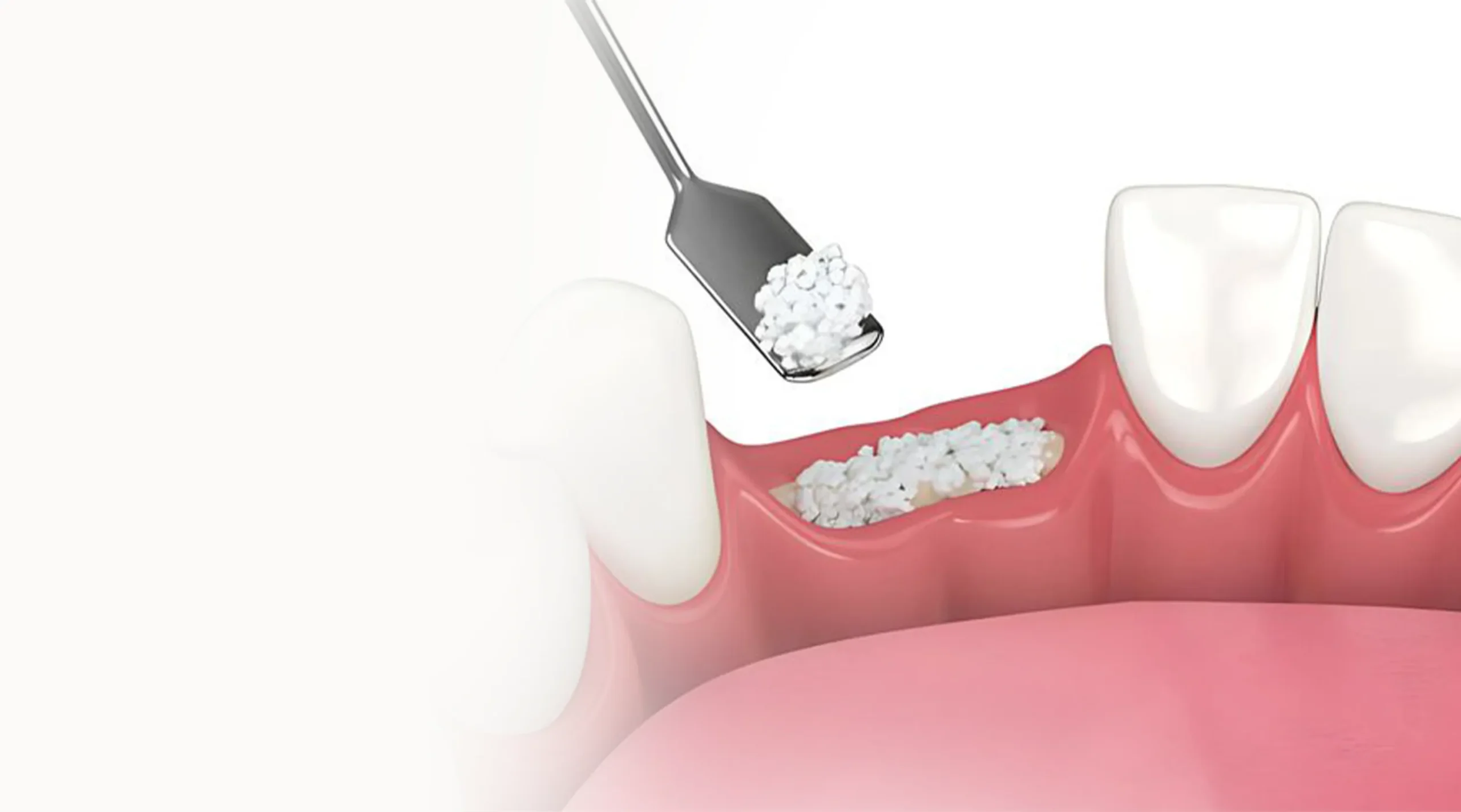
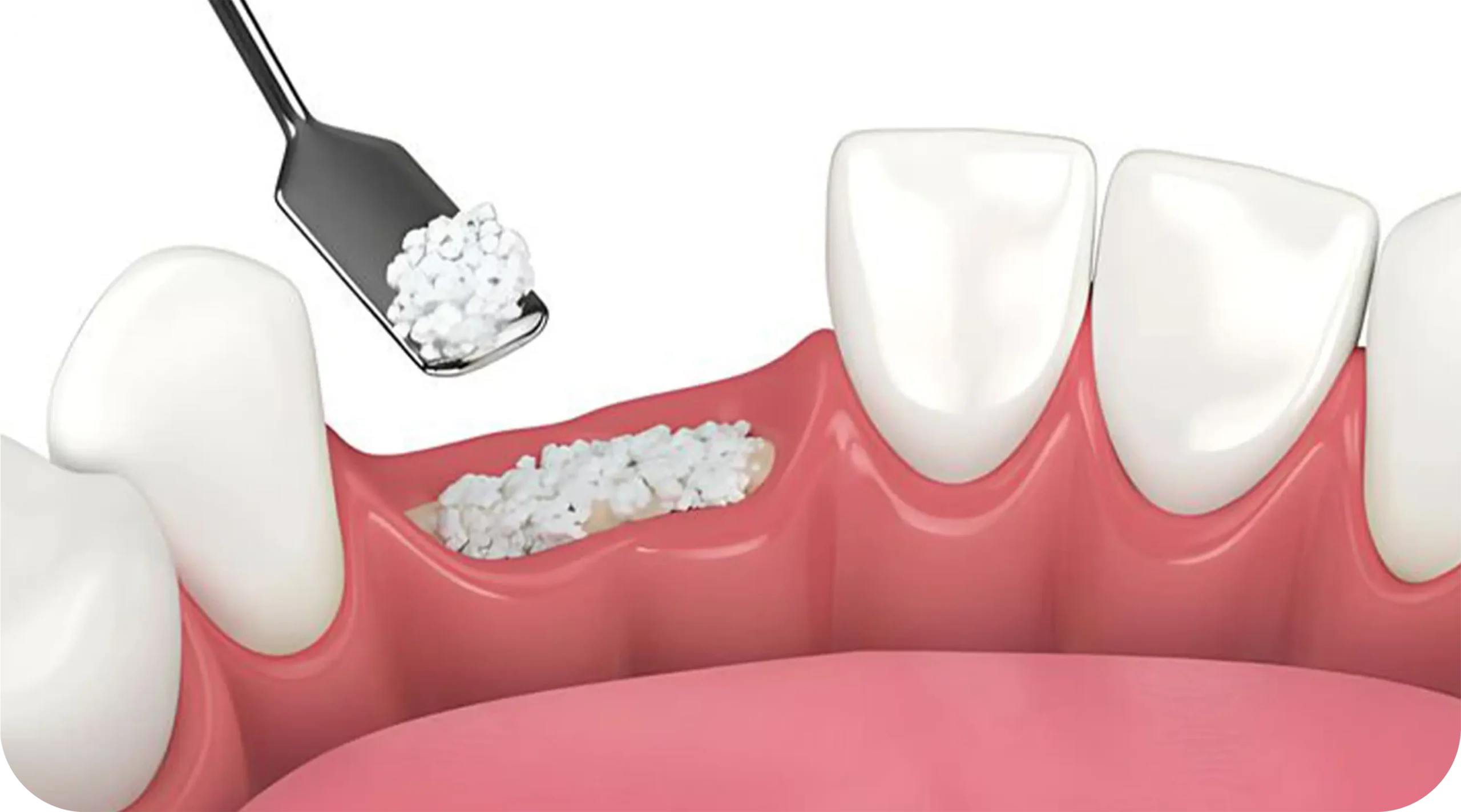
Bone grafting rebuilds the jawbone where it has shrunk, so an implant has something solid to anchor into.
Bone is not permanent scaffolding. It exists to carry load, and when a tooth is lost the root stops transmitting bite force into the jaw. The body reads that area as unused and reclaims it. Most of the loss happens within the first year after an extraction, and it continues quietly for years afterwards.
An implant needs bone around it on every side. Too little width and the threads sit exposed; too little height and the implant cannot reach a stable depth. An implant placed into insufficient bone does not fail dramatically on day one. It fails slowly, two or three years later, once the crown is on it and paid for — which is the worst possible time to find out.
A graft puts that missing volume back. Mineral granules are packed into the deficient site and covered with a resorbable membrane to stop soft tissue growing in, and over the following months your own bone cells migrate through the material. The graft does not remain as a foreign block in your jaw. It is a scaffold your body replaces with living bone.
Bone loss is invisible from the outside. A jaw that looks perfectly normal in the mirror can be three or four millimetres too narrow for an implant, and a panoramic X-ray will not reliably show it — it flattens a curved jaw into one plane and says nothing useful about width. A 3D scan measures height, width and density at the precise site where the implant will go. That is the difference between planning a case and guessing at one.
Patients hear "you need a graft" as bad news. It is the opposite. It means the case is being planned on what your scan actually shows rather than on hope. The clinics that never mention grafting are not finding more bone than we do — they are placing implants into less of it.
Bone grafting is not a single operation. The technique is chosen from what the 3D scan shows, and four situations cover almost every case.
Done at the same appointment as the extraction. Graft material goes straight into the empty socket before it has the chance to collapse inwards. This is the simplest grafting there is, and it prevents a problem rather than correcting one. If you know a tooth is coming out and an implant is coming later, ask for it at the time.
For a jaw that has already narrowed or flattened, usually years after the tooth was lost. Graft material is placed against the deficient ridge and held under a membrane while it consolidates. Width can be rebuilt very reliably. Height is harder, takes longer, and we will be straight with you about what is realistic.
In the upper back jaw the sinus floor sits low, and after tooth loss it drops lower still. The sinus membrane is lifted and graft material placed beneath it, creating the height an implant needs. We treat this as its own procedure with its own planning rather than folding it into a general graft.
Where the deficit is small, the graft goes in during the same surgery as the implant. Exposed threads are covered with graft granules and a membrane, and everything heals together. No separate waiting period and no second procedure — but this only works where the implant already achieves primary stability in your existing bone.
The 3D scan measures bone width and height in millimetres at the exact site where the implant will sit. Not an estimate from a panoramic film, not a judgement from looking in your mouth. That measurement determines which of the above applies, and it is taken before you commit to anything.
It also determines your schedule. A small graft placed alongside the implant adds no extra visit at all. A substantial graft has to heal first, and the implant follows months later. We tell you which applies to your case before you book anything, because it changes how the whole treatment is sequenced.
Local anaesthetic, one appointment, usually under an hour for a single site. The gum is opened, the graft material placed and shaped, the membrane positioned, the gum closed with sutures. You walk out the same day. Swelling and tenderness for two or three days is normal and settles with ordinary painkillers. There is no general anaesthetic and no overnight stay.
Where implants follow, we place MegaGen as our primary system and Straumann as the secondary option, and they go in only once the grafted site has been confirmed ready on a second scan.
Health matters as much as the jaw does. Smoking, uncontrolled diabetes, active gum infection and certain bone medications all affect how graft material integrates. Most are managed rather than disqualifying, but they need to be known before surgery, not discovered during healing.
All three are established, and the choice comes down to the size of the defect and your own preference about source material:
Processed bovine bone mineral, sterilised so only the mineral scaffold remains. Decades of clinical record, slow to resorb, and it holds volume well — which is why it is the default for most ridge and sinus work.
Bone harvested from another site in your own jaw. It integrates fastest and most predictably because it is genuinely your own tissue, at the cost of a second surgical site and a slightly longer appointment.
Laboratory-made mineral granules that act purely as a scaffold for your own bone to grow into. No animal or donor source at all, which matters to some patients, with a slightly longer integration period.
A 3D scan answers this for certain, but bone grafting is usually on the table if you:
Not every case needs it. Where the deficit is mild, a shorter implant or an angled placement can sometimes avoid grafting altogether — and we would rather tell you that than add a procedure. The scan decides, and you see the scan.
The graft itself is one appointment. What takes time is the healing afterwards, and that happens at home rather than here:
A 3D scan measures bone height, width and density at the exact implant site. This decides whether you need a graft at all, which technique it calls for, and whether it can be combined with the implant.
One appointment under local anaesthetic. The site is opened, graft material packed into the defect and covered with a resorbable membrane, then the gum is closed. You leave the same day.
Swelling and tenderness for a few days, handled with ordinary painkillers. Soft food for a week, no pressure on the site, no smoking. Sutures dissolve or come out within about ten days.
Four to six months while your own bone replaces the graft material. This happens entirely at home — nothing to attend, nothing visible to watch, and no reason to stay in Albania for it.
A second scan confirms the grafted bone has the volume and density to hold an implant. Only then is it placed — MegaGen as standard, Straumann where the case calls for it.
We recommend a graft only when the scan shows one is needed, and we show you the scan. The material going into your jaw is named on your quotation, the implant system that follows it is named too, and if your case can be done without a graft, we will tell you that instead.
Explore our full range of treatments
No. The procedure is done under local anaesthetic, and what you feel is pressure rather than pain. Afterwards there is swelling and tenderness for two or three days — broadly comparable to having a tooth out — and ordinary over-the-counter painkillers handle it. Most patients are surprised by how mild it turns out to be relative to how surgical it sounds. You will have written aftercare instructions before you leave: soft food, no smoking, nothing hot for the first day, and leave the site alone.
Four to six months for most grafts, longer for large reconstructions. The waiting is not arbitrary. Graft material has to be replaced by your own living bone before it can hold an implant, and that process cannot be rushed. Placing an implant into a graft that has not consolidated is precisely how implants fail two years later. We confirm readiness with a second 3D scan rather than counting months on a calendar. If the bone is ready at four months, we proceed at four. If it needs longer, you wait — and we would rather say so than keep to a schedule that suits the booking diary.
No, and most implant cases do not involve grafting at all. Grafting becomes relevant when a tooth has been missing long enough for the ridge to shrink, when gum disease has already destroyed the surrounding bone, or when the sinus in the upper jaw sits too low for the implant length the case needs. A tooth extracted recently, in an otherwise healthy jaw, usually has enough bone for an implant with no augmentation whatsoever. The 3D scan answers this site by site, in millimetres. It is entirely normal to need a graft at one position and nothing at all at the position next to it.
Sometimes — and where it is possible, we do it, because it saves you a healing period and a visit. Simultaneous grafting works when the implant can achieve primary stability in the bone you already have, with the graft covering a small exposed area or filling a minor gap around it. The implant is anchored in real bone, and the graft consolidates around it while the implant integrates. Where the deficit is larger, the graft has to heal first. An implant needs something solid to grip on the day it goes in, and loose graft granules are not that. Your scan decides which applies, and we tell you before you travel, because it changes the number of visits.
You choose, within what the case allows. Xenograft is the most common: processed bovine bone mineral, sterilised and stripped of all organic material so that nothing but the mineral scaffold remains. It has decades of clinical record behind it and holds volume particularly well. Autograft is your own bone, taken from another site in your jaw. It integrates fastest, at the cost of a second surgical site. Synthetic graft is laboratory-made mineral granules with no animal or donor source at all, which matters to some patients for religious or personal reasons. Integration takes slightly longer. Whichever you choose is written on your quotation. You are entitled to know what is going into your jaw.
Then the implant goes into bone that cannot fully support it, and the usual outcome is delayed failure rather than immediate failure. An implant needs bone contact around its whole surface. Where the bone is too narrow, threads sit exposed against gum tissue. Where it is too short, the implant cannot reach a stable depth. It may feel perfectly fine for a year or two. Then the exposed surface accumulates bacteria, bone recedes further, and the implant loosens — typically well after the crown is on it and the invoice is settled. Any clinic can put an implant into insufficient bone, and some will. We would rather add one procedure now than redo the whole case later.
Yes, though it is uncommon, and it is usually recoverable. Failure means the graft does not integrate: it resorbs faster than your bone can replace it, or an infection disrupts healing. The main risk factors are smoking, uncontrolled diabetes, poor hygiene during healing, and disturbing the site too early. When it does happen, it shows up at the readiness scan — before an implant has been placed into it. That is exactly why we scan again instead of assuming. A failed graft is redone. A failed implant sitting in a failed graft is a much larger problem, and avoiding that is the entire purpose of the second scan.
Usually one short visit, and sometimes none at all. If the graft can go in at the same time as the implant, it adds nothing — same appointment, same healing period. If it has to heal first, the graft becomes its own visit: assessment, scan and placement, typically done within a day or two. The healing months happen entirely at home. There is nothing to attend, nothing to check, and no reason to stay in Albania while the bone consolidates. You come back when the readiness scan says it is ready.
Age on its own is not a barrier. Healing capacity and general health are what matter. We graft successfully for patients in their seventies and beyond. Bone remodelling does slow with age, so integration can take somewhat longer, but the biology still works exactly as described. What genuinely changes the picture is medication. Bisphosphonates and related bone drugs, often prescribed for osteoporosis, alter how bone responds to surgery and must be disclosed before any planning is done. Bring your full medication list to the assessment — it matters considerably more than your date of birth.
Yes. It is the single biggest thing within your control. A graft depends on blood vessels growing into it from the surrounding bone. Nicotine constricts exactly those vessels, and the heat and chemistry of smoking impair healing at the surgical site directly. Smokers have measurably higher graft and implant failure rates, and this is one of the most consistent findings in implant dentistry. We will still treat you. But stopping for two weeks before surgery and the first month after it changes your odds meaningfully, and we would rather say so plainly than let you discover it the expensive way.
For a standard ridge graft or socket preservation, yes — most patients travel the following day without any difficulty. Sinus work is the exception. After a sinus lift, pressure changes matter, and we normally ask you to wait, alongside avoiding nose-blowing and anything else that pressurises the sinus for a short period. We tell you exactly how long, based on what was actually done. Either way, book your return with a day of slack. Not because complications are likely, but because travelling the same afternoon as oral surgery is unnecessarily uncomfortable.
Send us a few details and our patient coordinators will come back within 24 hours with a treatment plan, timeline, and price. No obligation.