Several missing teeth in a row replaced on two or three implants
Replace several missing teeth in a row without a single healthy tooth ground down for support — just two or more implants doing the work.

 1000+ Google reviews

 Excellent on Trustpilot
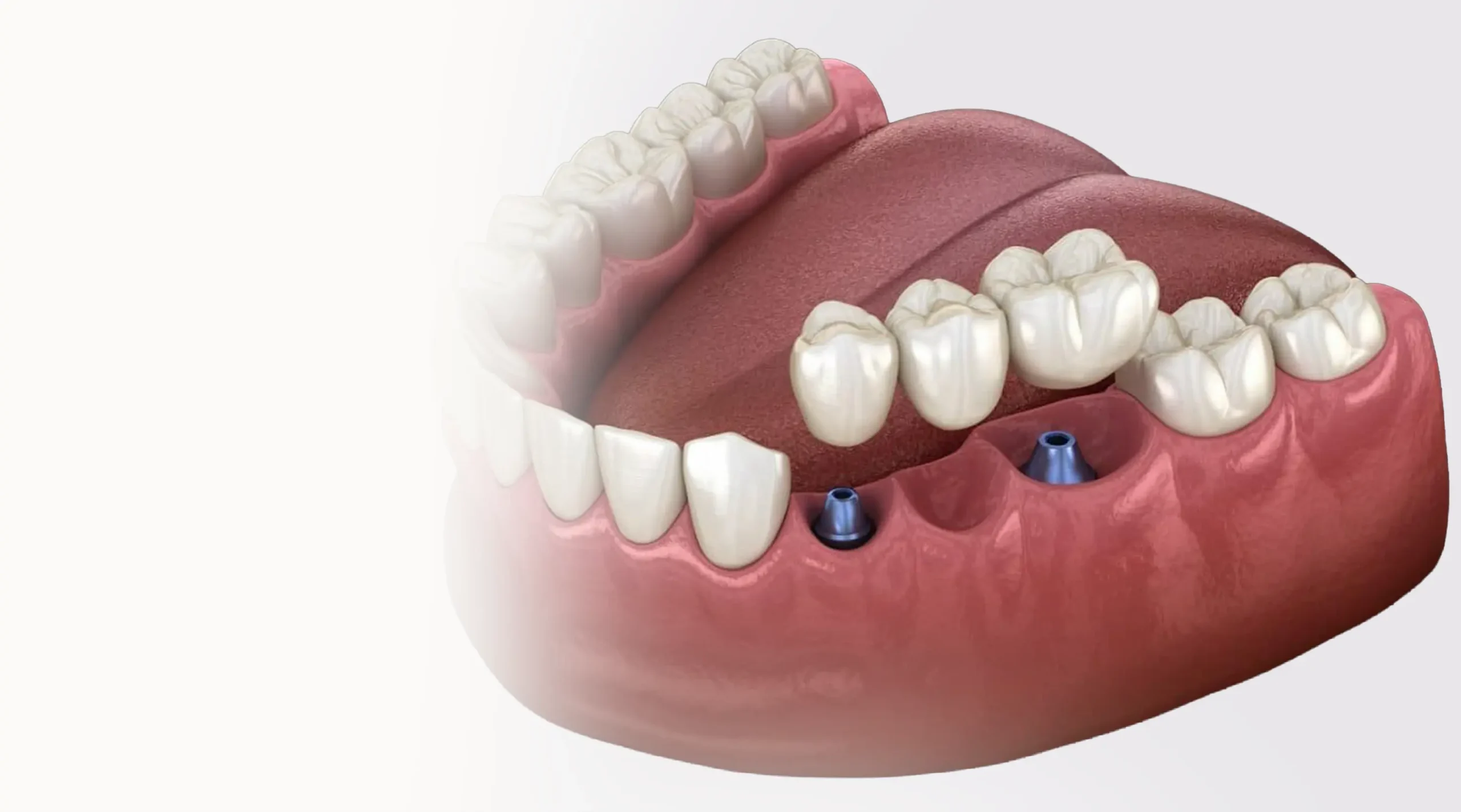
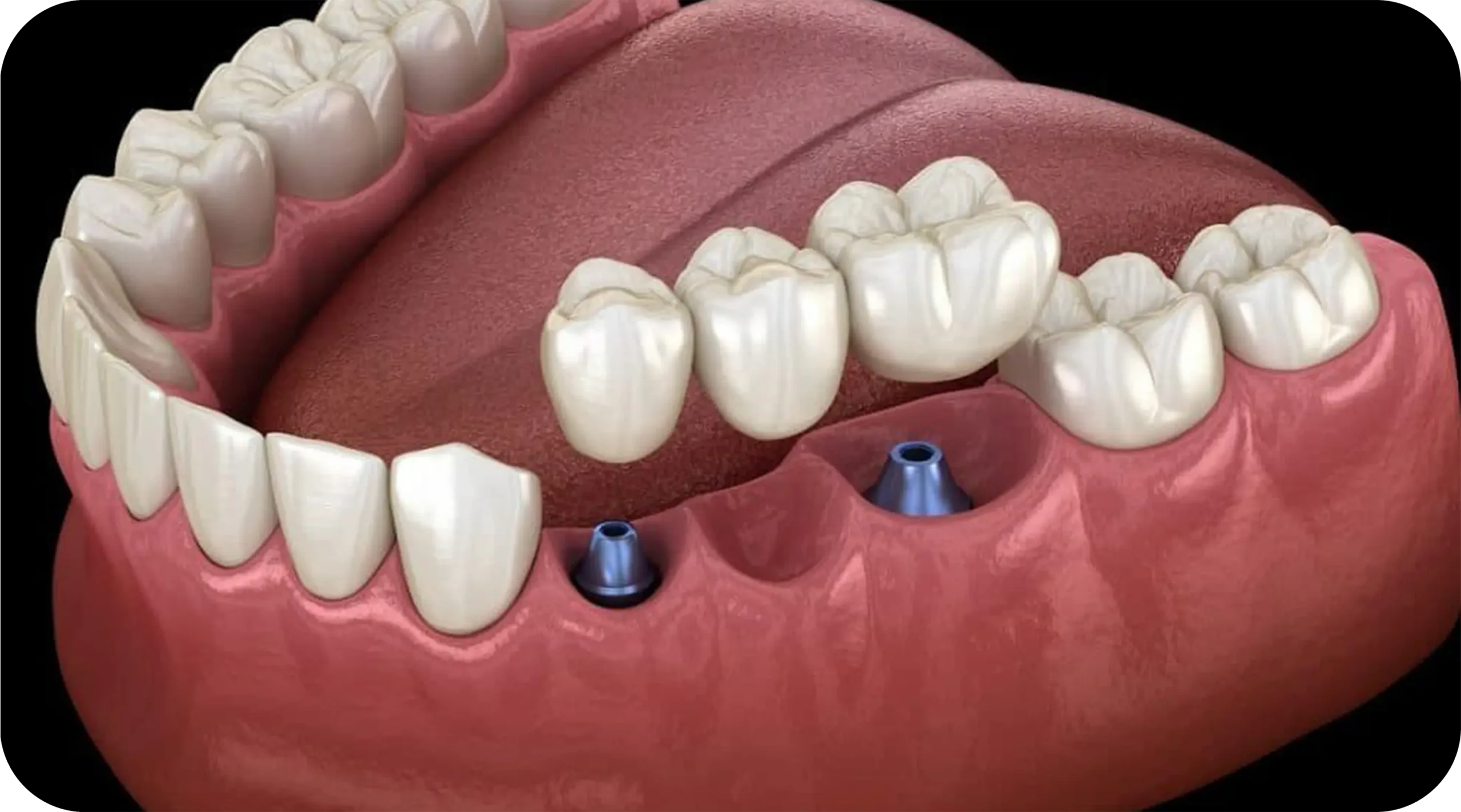
An implant-supported bridge replaces several missing teeth in a row, carried on two or three implants rather than one per tooth.
That sentence contains the whole argument for an implant-supported bridge. You do not need an implant for every missing tooth, and understanding why is what makes this treatment affordable rather than daunting.
Implants are extremely strong in compression. A bridge built across two of them behaves as a single unit, distributing bite force between the anchors rather than asking each replacement tooth to stand alone.
So a three-tooth gap usually needs two implants, with the middle tooth suspended between them. A four-tooth span often needs two or three.
The saving is not marginal. Three separate implants means three surgical sites, three sets of components and three healing processes. Two implants and a bridge means one procedure, one healing period and a visibly smaller quotation — for a result nobody can tell apart.
A partial denture. Clasps, movement, something in a glass at night, and gums bearing load they were never designed for. A fixed bridge ends all of that and restores most of your natural bite force.
A conventional bridge. Carried by your own teeth, which have to be filed down to take crowns — two healthy teeth permanently altered and then asked to carry the work of four. When one of them eventually fails, the bridge goes with it.
Nothing at all. The most common option, and the most expensive over time. A span of missing teeth lets the neighbours tilt inwards, the opposing teeth drift down into the space, and the bone underneath shrink year after year.
This is the treatment where the price gap between Western Europe and Tirana is at its widest, because the case is large enough for overheads to compound.
What does not change is what goes into your jaw. The implants are MegaGen or Straumann. The zirconia is Zirkonzahn. The difference is rent, salaries and the cost of running a clinic — not the specification.
An implant-supported bridge has two parts: the implants in the bone, and the bridge that spans them. They are made, fitted and replaced on completely different timescales.
The implants are titanium posts placed into the jaw at the positions the scan identifies as strongest. They are not necessarily directly under the missing teeth — they go where the bone is.
The bridge is a single unit made in the lab, with crowns at each end that sit on the implants and one or more suspended teeth between them. It is screwed or cemented onto the implants and removed only by a dentist.
Three things: the length of the span, the bone available at each candidate site, and where your bite force lands.
A three-unit bridge in the lower jaw, where bone is dense and cortical, is a different proposition from the same span in the upper jaw, where bone is softer. Longer spans need more support, not because the bridge would break but because the implants at each end would carry too much leverage.
The scan answers this before anything is planned, and the number goes on your quotation with the reasoning attached. It is worth knowing that more implants means a larger invoice — which is exactly why the recommendation should come from the bone rather than from the price list.
A common misunderstanding is that the implants should sit evenly under the gap. They should sit where the bone is best.
This is the real flexibility a bridge has over individual implants. Where a single implant must go under the tooth it is replacing, a bridge can be anchored slightly forward or back to reach denser bone, avoid the sinus, or stay clear of the nerve — and the bridge design absorbs the difference.
It is also why cases that look difficult for individual implants are often straightforward as an implant-supported bridge.
A span missing for years will have lost width and height along the ridge.
Often the answer is simply to place the implants where the bone remains. Where that is not enough, grafting rebuilds the site, and in the upper back jaw a sinus lift may be needed to gain height beneath the sinus floor. Both add a stage and some healing time.
The scan tells us which of these applies. We say so before you book flights.
There is a point where a bridge stops being the right answer.
If most of the teeth in a jaw are gone or failing, restoring them as separate bridges is more complex and more expensive than treating the whole arch at once. At that stage All-on-4 or All-on-6 is usually both cheaper and more predictable.
We will tell you honestly which side of that line your case falls on. It is not always the answer people expect.
Health matters as much as the jaw does. Uncontrolled diabetes, active gum infection, heavy smoking and certain bone medications all affect how well implants integrate, so we review your medical history before planning. Most are managed rather than disqualifying — but they need to be known in advance, not discovered halfway through.
Both are established choices with long clinical records. Which suits you depends on where the bridge sits, how hard you bite, and budget:
Our zirconia comes from Zirkonzahn in South Tyrol. Strong enough for back teeth, stain resistant, and it transmits light the way a tooth does — which matters most where the bridge shows when you smile.
Porcelain layered over a metal framework. A long clinical record, excellent under heavy bite forces and typically lower in cost. The trade-off is appearance: the metal core does not let light through.
An implant-supported bridge is usually the right answer if you:
The number of implants is decided by your bone and your bite, not by the number of teeth missing. Three teeth in a row very often need only two implants — and where the span is longer, we will tell you what it actually requires rather than quoting the cheapest arrangement.
An implant-supported bridge takes two visits to Tirana, separated by a healing period at home. Everything except the waiting is short:
A full examination and 3D scan. Bone volume and density along the span decide how many implants are needed and exactly where they go — this is the stage that determines the cost of the whole case.
The implants are placed under local anaesthetic in one appointment. Two or three implants take little longer than one, because the preparation is shared across the site.
Three to six months while the implants fuse with the bone. You go home and carry on normally, and we stay reachable by phone and email throughout.
On your second visit we take measurements and send them to the lab, where the bridge is built as a single unit to match your remaining teeth in shade and shape.
The bridge is fitted onto the implants, the bite adjusted across the whole span, and the undersides finished so you can clean beneath it properly.
We tell you how many implants your case needs and why, before you travel, and both the implant system and the bridge material are written on your quotation. More implants means a bigger invoice, which is precisely why you should be told what the scan shows rather than what sells.
Explore our full range of treatments
An implant-supported bridge exists precisely because you usually do not need one, and paying for teeth you do not need is not a better outcome. Implants are remarkably strong in compression. Two well-placed implants can comfortably carry a three-unit bridge, with the middle tooth suspended between them. Four teeth in a row can often be carried on two or three. The bridge distributes the load across the implants rather than each tooth standing alone. The saving is substantial. Three individual implants means three surgical sites, three healing processes and three sets of components. Two implants and a bridge means one procedure, one healing period, and a noticeably smaller invoice for the same visible result. There are cases where individual implants are better — where the teeth are not adjacent, or where a particular site needs its own support. We will say so. But where the gap is continuous, a bridge is usually the more sensible engineering.
Two or three for most cases, and it is decided by the scan rather than by the number of teeth. What determines it is the length of the span, the quality and volume of bone at each potential site, and where your bite force lands. A three-unit bridge in the lower jaw, where bone is dense, behaves differently from the same span in the upper jaw, where it is softer. We will tell you the number before you travel, with the reasoning, and it goes on your written quotation. Worth knowing that more implants means a bigger invoice — which is exactly why you should be told what your bone supports rather than what would be convenient to sell. If the honest answer is that your case needs three rather than two, we will say that too.
They solve the same problem in completely different ways. A conventional bridge is carried by your own teeth. The two healthy teeth either side of the gap are filed down to take crowns, and the replacement teeth hang between them. No surgery, faster, cheaper up front. The costs are that two healthy teeth are permanently altered, that those teeth now carry the load of three or four, and that the bone under the gap keeps shrinking. An implant-supported bridge is carried by implants in the bone. Your own teeth are not touched. The bone is loaded and maintained. It costs more and takes months rather than weeks. The longer the gap, the more the balance tips towards implants. Asking two teeth to carry a four-unit conventional bridge is a lot to ask of them, and when one of those teeth eventually fails you lose the bridge with it.
For most people, yes, and the difference is not subtle. A partial denture rests on the gums and clips onto remaining teeth with clasps. It comes out at night, it moves when you eat, the clasps are often visible, and over time they can loosen the teeth they hook onto. It also does nothing to preserve bone. An implant-supported bridge is fixed. Nothing to remove, nothing that moves, no clasps, and most of your natural bite force restored because the load transmits into bone rather than pressing on gum tissue. A partial denture is considerably cheaper and remains a reasonable interim option, particularly while a site heals. But as a permanent answer it is a compromise that most patients eventually want to move on from.
The implants and the bridge in an implant-supported bridge age differently. The implants are titanium fused into living bone. With healthy gums and consistent hygiene they commonly last decades and often for life. What threatens them is peri-implantitis — inflammation around the implant driven by plaque — which is largely preventable. The bridge is a restoration and wears like one. Expect somewhere in the region of 10 to 15 years before it may need replacing, depending on material and bite force. Replacing it is a prosthetic job, not a surgical one, because the implants underneath stay where they are. The expensive, invasive part happens once. Over a twenty-year horizon that is what makes this cheaper than it looks against a conventional bridge that may need redoing along with the teeth holding it.
No more than a single implant, and often proportionally less than you would expect. The site is numbed with local anaesthetic. Placing two or three implants in one area takes little longer than placing one, because the access and preparation are shared. You feel pressure and movement, not pain. Afterwards, expect swelling and tenderness for a few days, manageable with ordinary painkillers. Most patients are back to normal activity within a couple of days. If you are anxious about the surgery, say so when you book rather than on the day. It is a common and reasonable concern and easier to plan around in advance.
Yes. The implants need three to six months to fuse with bone before a bridge can be loaded onto them, and that timeline is set by healing rather than by scheduling. The first visit covers examination, scan and placement. The second covers measurements, fabrication and fitting. Both are short — three to five days is typical for the first, less for the second. Any clinic offering a permanent implant bridge inside a week is either fitting a temporary and calling it final, or loading a bridge onto implants that have not integrated. The second is a risk you carry home and discover months later.
It is more common over a long-standing gap than a recent one, and it rarely rules treatment out. Bone is maintained by load. Across a span where several teeth have been missing for years, the ridge will have lost width and height. The 3D scan shows exactly how much is left and where. Sometimes this simply changes where the implants go — the bridge design has flexibility that a single implant does not, because the implants can be positioned where the bone is best rather than directly under each missing tooth. Where grafting is genuinely needed, it adds a stage and some healing time. In the upper back jaw a sinus lift is sometimes required. We will tell you before you book flights, not after you arrive.
Zirconia for most cases, and particularly where the bridge shows when you smile. Zirconia is strong enough for the back of the mouth, resists staining, and transmits light in a way that reads as tooth rather than as a flat block of colour. Ours comes from Zirkonzahn in South Tyrol. Porcelain-fused-to-metal has a very long clinical record and handles heavy bite forces well, at a lower cost. The trade-off is optical: the metal substructure blocks light, so it can look slightly more opaque, and over many years a dark line can appear at the gum margin. If the bridge is at the back and out of sight, metal-ceramic is a perfectly sound choice and the saving is real. We go through both with you before anything is made.
This is the part that actually determines how long an implant-supported bridge lasts, and it is different from cleaning natural teeth. There is a space between the underside of the bridge and your gum. Plaque collects there, and brushing the outer surfaces does not reach it. You need to clean underneath the span, every day. Superfloss or an interdental brush threaded under the bridge works well; most patients find a water flosser easier and end up using one daily. We show you exactly how before you fly home and you leave with written instructions. It takes an extra minute or two a day. That minute is the difference between a bridge that lasts a decade and one that lasts considerably longer, because peri-implantitis is what ends these cases and it starts precisely where people cannot reach.
It is uncommon, and a bridge handles it better than you might think. Most failures happen early, in the first months, when an implant does not integrate as expected. Because the bridge is carried on more than one implant, losing one does not mean losing the whole case. Depending on the span and which implant it is, the bridge can sometimes be redesigned around the remaining implants, or the failed site left to heal and a replacement placed. Late failures, years afterwards, are almost always peri-implantitis from plaque — which is why the cleaning routine and annual check-ups carry the weight they do. Contact us if anything feels loose or uncomfortable. We will tell you plainly what happens if something goes wrong before you book, not after.
4.9
/ 1006 reviews
“I travelled from the UK for 3 dental implants and was so nervous, but the team made me feel comfortable and reassured every step of the way. Dr Idris and his team were professional and genuinely caring.”
“My whole experience with HMC has been incredible. I was a bit scared about travelling from the UK to get an implant done, but there was nothing to be scared of. The procedure was quick and painless and they supported me 24/7 once I got back home.”
“I had a great experience with my dental implant. The doctor was very professional, patient, and made me feel comfortable throughout the whole process. The entire staff made the experience easy and stress-free. Would definitely recommend!”
Send us a few details and our patient coordinators will come back within 24 hours with a treatment plan, timeline, and price. No obligation.